Cinematic Educational Catalog
Select any module to begin an immersive interactive lecture.
Recommended for You
Personalized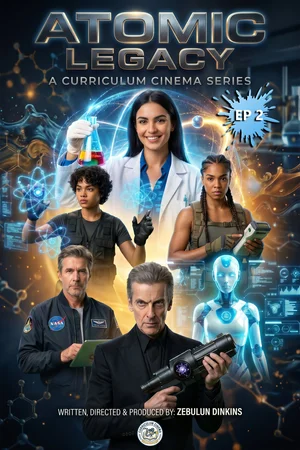
EPISODE 2: FORCES IN MOTION
The discovery of an intelligent crystalline material leads the Element Protocol team into a series of experiments revealing how molecular structure determines the strength and function of engineered materials. As Chancellor Vex manipulates matter itself, the team must also investigate thermal energy transfer and entropy to restore balance before their laboratory collapses.
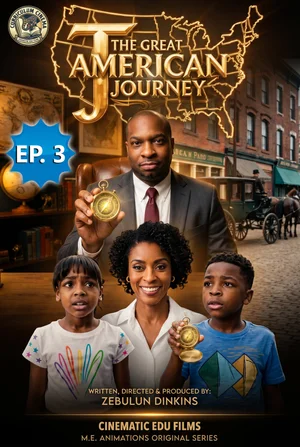
Episode 3: America as a World Leader
Maya and Jaden travel with the magical compass, Spark, into one of the most challenging periods in world history—the years leading up to and following World War II. Their journey begins during the global economic struggles of the 1930s, where they witness the rise of powerful dictators in Europe and Asia whose aggressive ideologies and expansionist goals push the world toward war. As tensions grow, Maya and Jaden observe America’s debate over staying neutral before eventually entering World War II after the attack on Pearl Harbor. They experience both the European and Pacific theaters of war, learning how geography, technology, and military strategy shaped the conflict. The students also encounter the devastating human impact of the Holocaust and learn how discriminatory government policies targeted millions of innocent people. Through survivor stories and historical perspectives, they explore the importance of human rights and standing against hatred and persecution. Following the war, Maya and Jaden witness America emerge as a global leader by helping rebuild Europe, supporting displaced persons, and forming international alliances like the United Nations and NATO. By the end of the journey, they understand how World War II transformed the United States into a major world power and reshaped global politics forever.
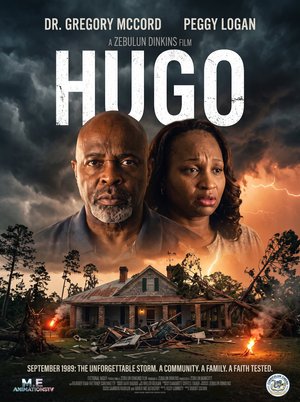
HUGO
When Hurricane Hugo barrels toward Charleston County in September 1989, the Vance family prepares for what they believe will be a dangerous night. But as the storm intensifies, their home becomes a battleground against hurricane-force winds, rising floodwaters, collapsing structures, and failing power. Retired Navy commander Elias Vance struggles to protect his family while confronting memories of loss, as his son David fights to keep everyone safe, teenage Julian is forced to grow up quickly, and Clara—eight months pregnant—goes into labor as Hugo tears through the Lowcountry. Trapped together in the darkness, the family must overcome fear, conflict, and impossible conditions to survive one of South Carolina's most devastating storms.
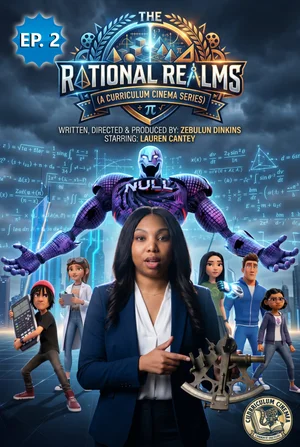
Episode 2: “THE EQUATION ENGINE”
After restoring balance to the Integer Districts, the heroes discover a hidden power source called the Equation Engine — a massive machine that controls every mathematical function inside the Rational Realms. But Lord Null infects the system with corrupted variables and unstable expressions, causing equations to spiral out of control. To stop the collapse, the team must master algebraic expressions, powers, variables, inverse operations, properties, equations, inequalities, and functions before the entire digital universe shuts down.
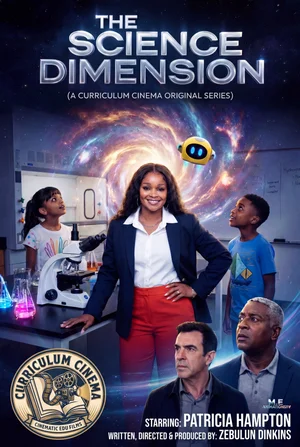
THE SCIENCE DIMENSION
Episode 1 Synopsis: “The Ripple Effect” Ten-year-old science lovers Maya Johnson and Jayden Carter are excited to present their newest invention at the school STEM showcase when a strange citywide glitch suddenly shuts down phones, computers, traffic lights, and communication systems. The source is revealed to be the mysterious villain Dr. Static, who has launched a device that scrambles all signals across the city. With help from their brilliant mentor Professor Watts and floating AI assistant Spark, Maya and Jayden begin a mission to understand the science behind waves and communication. Starting with simple ripples in a pond, they discover that waves are repeating patterns of motion with different heights (amplitude) and spacing (wavelength), and that waves can even cause objects to move. As the team follows clues through a mirror maze, sound chamber, and signal tower, they learn how light reflection helps us see objects and how patterns like drum beats, flashlight signals, and binary code can be used to send messages over long distances. In the final showdown, Maya and Jayden must use everything they’ve learned about waves, light, and coding patterns to restore the city’s communication network before Dr. Static permanently disconnects the world. Disciplinary Core Ideas (DCIs) ✔ PS3.A – Definitions of Energy Speed relates to energy ✔ PS3.B – Conservation of Energy and Energy Transfer Energy transferred through sound, light, heat, and electricity ✔ PS3.D – Energy in Chemical Processes and Everyday Life Stored energy in batteries converted for practical use ✔ ETS1.A – Defining Engineering Problems Designing within constraints
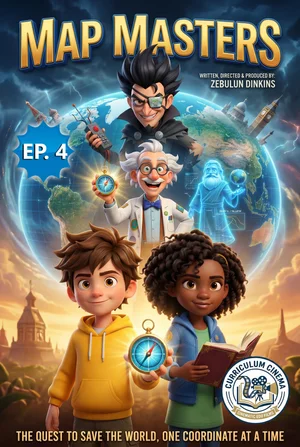
EPISODE 4: THE THIRTEEN COLONIES
The Colonial Timeline is breaking apart. Jayden and Mia journey through Jamestown, Plymouth, the New England Colonies, the Middle Colonies, and the Southern Colonies to discover how economics, government, and cultural interactions shaped early America. Along the way they explore multiple perspectives and learn how colonial life set the stage for future conflicts with Britain.
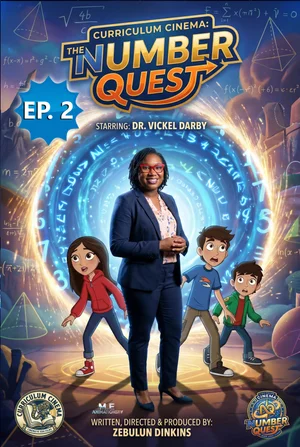
Episode 2: The Multiplication Maze:
Maya, Jordan, and Leo journey into the dangerous Multiplication Maze after Dr. Chaos hides the second Crystal Fragment deep inside its shifting walls. To survive, the team must solve challenges involving factor pairs, prime and composite numbers, multiplication, division, patterns, and algebraic equations. As giant robot guardians, collapsing bridges, and changing tunnels block their path, the heroes discover that every part of the maze follows mathematical rules and patterns. Using teamwork and problem-solving skills, they battle Dr. Chaos’s Equation Beasts and solve real-world two-step problems to unlock the Crystal Chamber. But just as they recover the fragment, Dr. Chaos unveils his terrifying new invention — the Equation Storm Engine — a machine powerful enough to erase math from the kingdom forever. STANDARDS COVERED: 4.PAFR.3.1 4.PAFR.3.2 4.PAFR.3.3 4.PAFR.3.4 4.PAFR.1.2 4.PAFR.1.3 4.PAFR.1.4 4.PAFR.3.2 4.PAFR.3.4
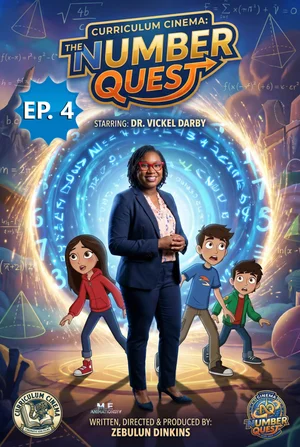
Episode 4: “The Decimal Dimension” (Decimals)
After recovering the Fraction Crystal, Maya, Jordan, and Leo are pulled into the futuristic Decimal Dimension, a high-tech world controlled by Dr. Chaos and his giant mechanical decimal monster. Inside the glowing city of numbers, the heroes must use their understanding of decimals, measurements, geometry, money, time, area, and perimeter to survive dangerous puzzles and restore balance to Math Kingdom. As collapsing streets, giant measurement labs, and shape-powered fortresses stand in their way, the team learns how fractions and decimals are connected while solving real-world problems involving elapsed time, unit conversions, purchases, and geometric classifications. In the final showdown, the heroes battle Dr. Chaos inside the massive Decimal Core, where one wrong decimal comparison could destroy math forever. Using teamwork and mathematical reasoning, they must stop the Equation Storm Engine before the entire kingdom is erased. STANDARDS:4.NR.2.1 4.NR.2.2, 4.MGSR.1.1 4.MGSR.1.2 4.MGSR.2.1 4.MGSR.2.2 4.MGSR.2.3 4.MGSR.2.4 4.MGSR.2.5, 4.MGSR.3.1 4.MGSR.3.2 ✅ Decimal notation ✅ Comparing decimals ✅ Fractions and decimals ✅ Area & perimeter ✅ Money calculations ✅ Elapsed time ✅ Measurement conversions ✅ Weight & length ✅ Triangle classification ✅ Quadrilateral hierarchy
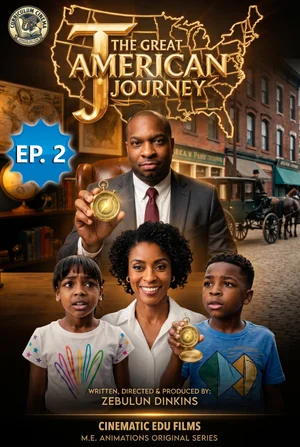
Episode 2: Federal Expansion
Brief Synopsis Maya and Jaden are swept back in time by the magical compass, Spark, to explore one of the most dramatic periods in American history between 1910 and 1940. Their journey begins in Europe during the rise of World War I, where they witness the tensions that pulled the United States into the conflict. From muddy trenches to patriotic rallies, they discover how war changed America politically and socially. Next, the students experience the excitement of the Roaring Twenties, where jazz music, new inventions, and the Harlem Renaissance transform American culture. But the celebration quickly turns into hardship when they witness the devastating 1929 Stock Market Crash and the struggles of families during the Great Depression, including mill workers and farmers in South Carolina. As the nation searches for hope, Maya and Jaden meet President Franklin D. Roosevelt and learn how New Deal programs expanded the role of the federal government through jobs programs, banking protections, and economic recovery efforts. Along the way, they explore multiple perspectives from citizens, workers, and business owners to understand how these historic events reshaped the United States and South Carolina forever. Standards Covered Standard 2: Demonstrate an understanding of how international events and conditions during the early 20th Century (1910–1940) affected the United States and South Carolina. Enduring Understanding: The economies of the United States and South Carolina experienced both prosperity and hardship during this era. These events led to increased federal government intervention to stabilize the economy and support citizens. Specific Standards Covered 5.2.CO Compare the cultural and economic impacts of the 1929 Stock Market Crash on the United States and South Carolina. 5.2.CE Examine the primary causes of World War I and the events that led to U.S. involvement. 5.2.P Summarize how the role of the federal government expanded during the period. 5.2.CX Contextualize the post-war economic climate and cultural changes, including: The Roaring Twenties Harlem Renaissance Expanded roles for women Cultural changes for African Americans 5.2.CC Examine continuities and changes resulting from New Deal programs, including: FDIC CCC Social Security Administration SEC TVA 5.2.E Evaluate multiple perspectives using primary and secondary sources related to: World War I The 1920s The Great Depression The New Deal
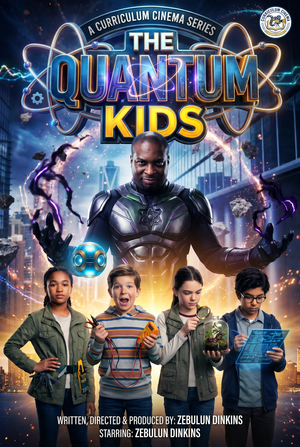
THE QUANTUM KIDS
In the futuristic city of Nova Springs, four brilliant kids discover a hidden underground laboratory built by a missing scientist known as Professor Orion. Inside the lab is a powerful AI sphere called ATOM, capable of shrinking the team down to microscopic size and transporting them through worlds made entirely of particles, energy, forces, and living systems. Each episode sends the team on a cinematic mission where science concepts become real adventures. Together, they must stop the mysterious villain Dr. Void, who wants to disrupt the balance of matter and energy across Earth.
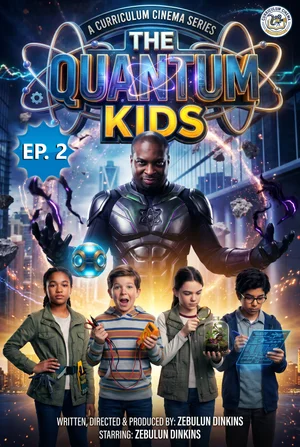
Episode 2: “THE LOST FOREST CODE”
The Quantum Kids journey into a living ecosystem after Dr. Void blocks sunlight from reaching Earth.
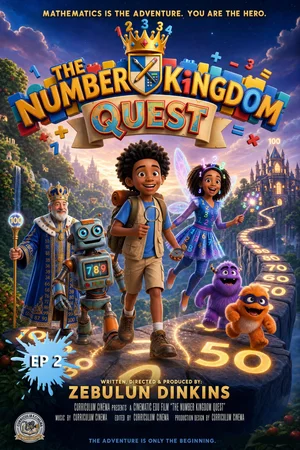
Episode 2: The Addition Crystal
When the magical Addition Crystal shatters into pieces, Milo and his friends travel through Math Valley solving addition and subtraction challenges. They learn to build and break apart numbers, make combinations of ten, and unlock the Pattern Palace through repeating patterns.
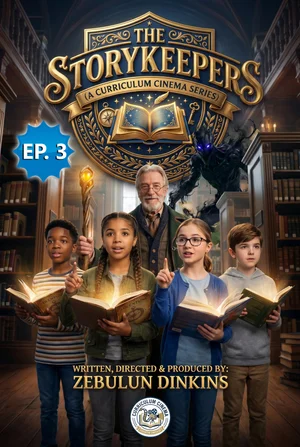
Episode 3: “THE ARCHIVE OF TRUTH”
When the magical Archive of Truth is attacked by the Ink Shadow, facts begin changing, sources disappear, and false information spreads across the literary worlds. Maya, Jaylen, Sophia, and Eli must become true researchers, writers, and communicators to restore knowledge before the entire library loses the ability to tell truth from fiction. To save the Archive, the Storykeepers must investigate credible sources, organize evidence, avoid plagiarism, write arguments, create informational reports, develop narratives, revise their work, and present their findings to the Council of Stories. But the Ink Shadow has created its most dangerous weapon yet: A machine that rewrites history itself.
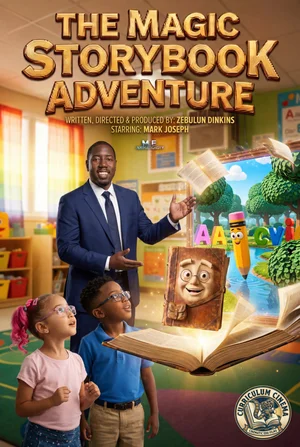
THE GREAT STORYBOOK ADVENTURE
THE MAGIC STORYBOOK ADVENTURE is a fun-filled educational fantasy film that follows two kindergarten friends, Mia and Max, as they are magically transported inside a living storybook by the mysterious Mr. Pages. Guided by their teacher, Mr. Lane, and magical friends along the way, the children journey through enchanted lands where they learn about characters, setting, plot, rhyming words, alliteration, onomatopoeia, informational texts, and the important roles of authors and illustrators. Through songs, challenges, and storytelling adventures, Mia and Max discover that every book holds a world of imagination and learning. Standards Covered ELA.AOR.1 ELA.K.AOR.1.1 Identify and describe main characters Identify setting Identify events that move the plot forward Understand problem and solution relationships Describe characters by: appearance feelings actions ELA.K.AOR.1.2 Identify figurative language including: alliteration onomatopoeia Recognize: descriptive words rhyming words ELA.AOR.2 ELA.K.AOR.2.1 Retell familiar stories using: characters setting beginning, middle, and end major events ELA.K.AOR.2.2 Retell informational texts by identifying: topic supporting details ELA.AOR.3 ELA.K.AOR.3.1 Identify the role of the author Identify the role of the illustrator Explain how words and pictures work together in stories
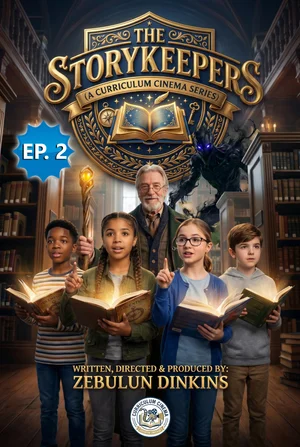
Episode 2: “THE LABYRINTH OF VOICES”
After restoring the first story world, the Storykeepers discover a mysterious realm where stories are being twisted from different perspectives. Inside the dangerous Labyrinth of Voices, characters disagree on the truth, poems lose their rhythm, informational texts become scrambled, and words begin changing meaning. To escape, Maya, Jaylen, Sophia, and Eli must analyze perspectives, identify author’s purpose, understand text structures, summarize stories, decode figurative language, use context clues, and uncover how multimedia elements shape meaning. But the Ink Shadow has evolved—and now it can manipulate the way stories are told.
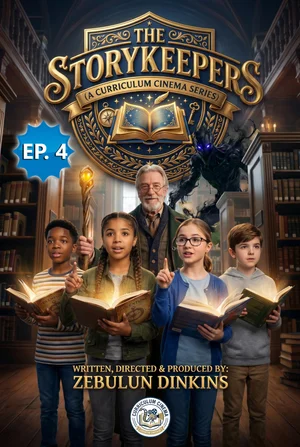
Episode 4: “THE FINAL CHAPTER”
The Storykeepers face their greatest challenge when the Ink Shadow unleashes the Final Chapter, a powerful force capable of rewriting every story, poem, article, and historical record in the Grand Library forever. As literary worlds begin colliding, Maya, Jaylen, Sophia, and Eli must master advanced reading skills to restore balance. To stop the collapse, they must analyze themes, compare points of view, trace arguments, uncover figurative meanings, examine multimedia portrayals, and understand how authors craft stories and informational texts. But the Ink Shadow has learned one final truth: If readers stop thinking deeply… stories lose their power. The fate of every world now depends on the Storykeepers’ ability to become true literary masters.
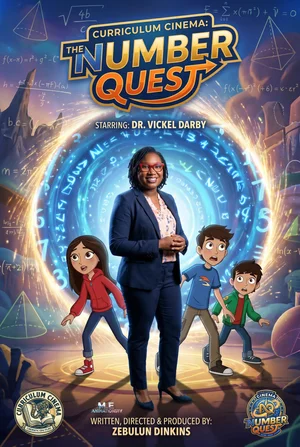
THE NUMBER QUEST
When a mysterious villain named Dr. Chaos steals the magical Number Crystal from Math Kingdom, numbers across the land become scrambled. Three young heroes—Maya, Jordan, and Leo—must travel through Place Value Mountain, Estimate Valley, and Addition Fortress to restore order. Along the way, they solve real-world math challenges involving ordering numbers, comparing values, rounding, estimating sums and differences, and solving addition/subtraction problems up to 100,000. If they fail, all math in the kingdom will disappear forever.
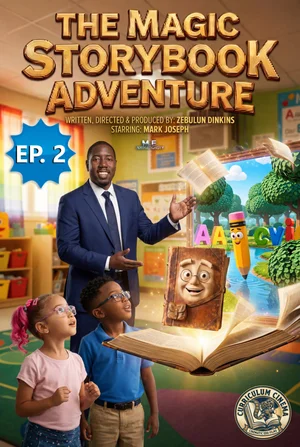
Episode 2: “THE FLUENCY FRONTIER” (THE GREAT STORYBOOK ADVENTURE)
After mastering basic story elements in Episode 1, Mia and Max return to the magical library where Mr. Pages introduces them to the Fluency Frontier — a fast-moving world where words come alive. To save the Story Train from losing its power, the friends must improve their reading fluency by decoding tricky words, using context clues, recognizing prefixes and suffixes, and reading with expression and accuracy. Along the way, they encounter magical metaphors, hilarious hyperboles, and silly idioms that challenge them to understand figurative language while discovering how characters grow throughout a story. STANDARDS: ELSCA.F.4: ELA.3.F.4.1 ELA.3.F.4.2 ELA.3.F.4.3 Applications of Reading (AOR) ELA.AOR.1: ELA.3.AOR.1.1 ELA.3.AOR.1.2 Indicator Insights: Evaluate and critique key literary elements that enhance and deepen meaning within and across texts. Explain how one or more characters develop throughout the plot. Identify and explain the purpose of forms of figurative language to include metaphor, hyperbole, and idioms.
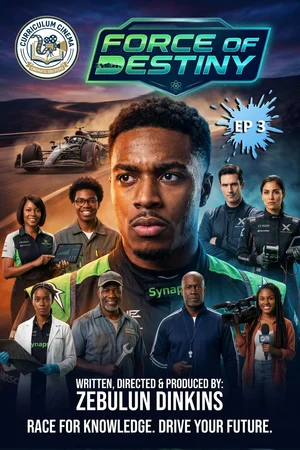
Episode 3: "WAVES OF VICTORY"
As the Formula 1 championship heats up, rising racing star Malik Johnson faces a new challenge when mysterious communication failures begin disrupting races. During a crucial Grand Prix, Malik loses contact with his pit crew, nearly causing a devastating crash and allowing rival champion Victor Kane to gain the upper hand. Determined to solve the problem, Malik teams up with Dr. Simone Carter and young engineer Jaden Brooks to investigate the science of waves and information transfer. Their journey takes them through the world of sound waves, electromagnetic radiation, fiber-optic communication, digital data storage, and the fascinating relationship between frequency, wavelength, and wave speed. As they design and refine a revolutionary communication system for their race team, Malik learns how waves carry information across the globe and how technologies such as radios, lasers, satellites, cameras, and fiber-optic networks depend on wave behavior. Along the way, the team explores the wave and particle nature of light, evaluates scientific claims about electromagnetic radiation, and discovers how modern devices transmit and capture information. When a massive communications blackout strikes during the championship race, Malik must rely on the team's newly engineered technology and his understanding of wave science to overcome the odds. In a thrilling finish, he proves that in modern racing, information can be just as powerful as speed.
Episode 2: The Ecosystem Crisis
The students enter EcoSphere, a digital world containing Earth's ecosystems. There they battle The Devourer, a rogue AI attempting to destabilize food webs, eliminate biodiversity, and collapse ecosystems. The team explores Yellowstone, kelp forests, the Serengeti, and Antarctic ecosystems while learning about carrying capacity, energy transfer, carbon cycling, ecological succession, and the importance of biodiversity.
Episode 3: The Evolution Protocol
The students travel into the Genetic Archive, where a villain called The Eraser seeks to eliminate genetic variation from life on Earth. To stop him, the team must explore DNA, chromosomes, mutations, meiosis, inheritance patterns, Punnett squares, fossil evidence, natural selection, and adaptation. Along the way they discover that diversity is the key to survival and evolution.
Episode 4: Earthbreakers – Secrets Beneath the Surface
When powerful earthquakes, floods, and violent storms suddenly begin tearing through the region, Maya, Jayden, Professor Watts, and Spark uncover the existence of the ancient TerraCore, a hidden machine capable of accelerating Earth’s natural processes. Behind the chaos is the dangerous scientist Dr. Rift, who plans to reshape the planet using the destructive power of Earth itself. To stop him, the team must investigate fossils, rock layers, canyons, erosion, volcanoes, and earthquake zones to uncover clues about how Earth has changed over time. As they explore collapsing caves, raging rivers, and underground chambers, they learn how water, wind, ice, and vegetation continuously shape the landscape. Using maps, scientific evidence, and engineering design, Maya and Jayden race to create solutions that can protect the city from natural disasters before the TerraCore triggers catastrophic destruction across the planet. 📘 Standards Covered 4-ESS1-1: Fossils and rock layers reveal Earth’s history 4-ESS2-1: Weathering and erosion shape Earth’s surface 4-ESS2-2: Earth’s features occur in patterns on maps 4-ESS3-1: Natural resources and energy affect the environment 4-ESS3-2: Engineering solutions reduce impacts of natural hazards
Episode 3: The Shape Castle Mystery
A mysterious Shape Castle appears in the Number Kingdom. To unlock its doors, Milo, Nova, and Count Bot must identify shapes, solve positional puzzles, compare flat and solid figures, and build shape creations that ultimately reveal the Golden Geometry Gem.
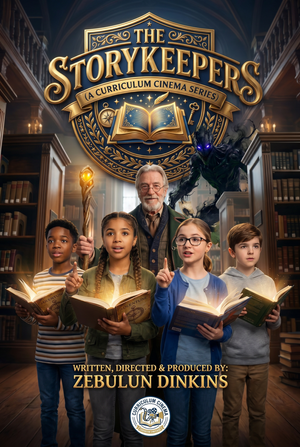
THE STORYKEEPERS
When a mysterious magical book called the Mirror of Meaning is stolen from the Grand Library of Imagination, four young students are pulled into famous story worlds where characters are trapped in broken plots. To restore the stories, the kids must uncover themes, analyze conflicts, understand figurative language, and discover how point of view changes the meaning of a story. As the worlds begin collapsing into chaos, the students learn that every story has a deeper meaning—and every reader has the power to unlock it.
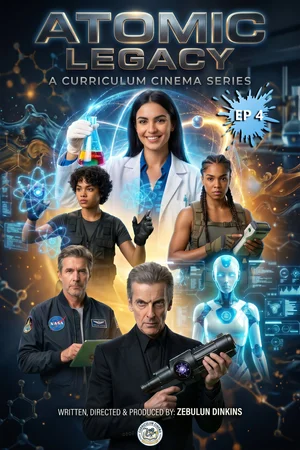
EPISODE 4: THE SPECTRUM CODE
As the Entropy Engine arrives in Earth's orbit, the only way to decode its message is through spectroscopy. Dr. Nova and her team analyze emission and absorption spectra, compare multiple data sources, and identify elements by their unique spectral fingerprints. Their evidence-based investigation uncovers an ancient archive of scientific knowledge and proves that careful analysis—not assumptions—is the key to discovery.
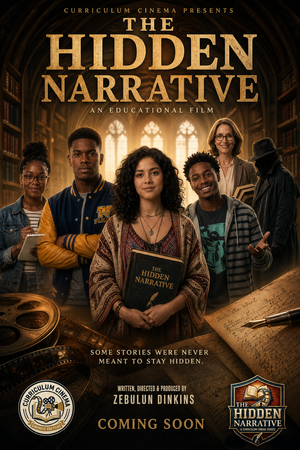
THE HIDDEN NARRATIVE
Students Maya, Jordan, Olivia, and Marcus discover an anonymous manuscript hidden in the school library. As they begin reading, they analyze perspective, theme, figurative language, irony, and author purpose. Their investigation uncovers clues suggesting the story may be connected to real events from the school's past.
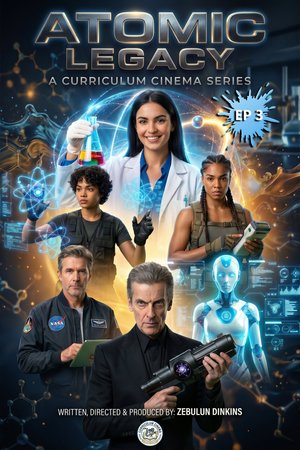
EPISODE 3: THE ENTROPY SIGNAL
A mysterious signal from deep space leads the team to investigate the electromagnetic spectrum while recreating thermal energy transfer inside sealed experimental systems. As they test scientific claims against experimental evidence, they discover that different wavelengths interact uniquely with matter, revealing a hidden warning encoded in light itself.
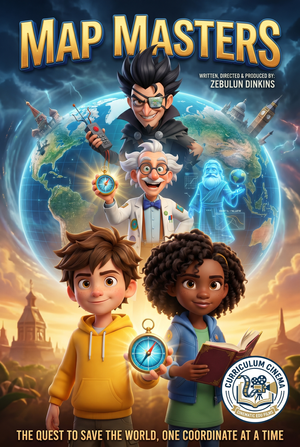
MAP MASTERS
Series Overview Join Jayden, Mia, Professor Globe, and Atlas as they travel through time to explore the people, places, cultures, and events that shaped Colonial America and the early development of the United States. Through exciting adventures, students learn history, geography, economics, government, and culture while helping restore the Timeline of History.
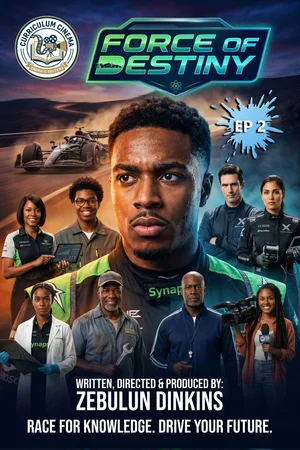
Episode 2: "POWER SURGE"
After winning his first race of the season, Malik Johnson discovers that Team Phantom X has unveiled a revolutionary energy system capable of storing and releasing enormous amounts of power during races. To stay competitive, Malik and his team must learn how energy moves through a racing system—from the car's engine and batteries to its wheels, brakes, and advanced electromagnetic technologies. As the championship intensifies, the team races against time to design a next-generation energy conversion system capable of transforming braking energy into racing power.
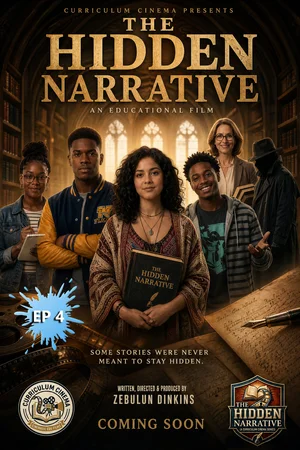
EPISODE 4: THE TRUTH IN INK (Finale)
The students finally uncover the truth behind the anonymous manuscript. To ensure the story is remembered, they must research, write arguments, create presentations, defend claims, address counterclaims, collaborate with peers, and present their findings to the school board in a dramatic final showdown of evidence and ideas.
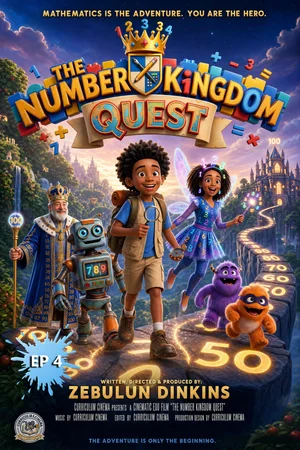
Episode 4: The Great Measurement Mystery
When the Golden Measuring Wand disappears before the Number Kingdom Fair, Milo, Nova, and Count Bot set out to find it. Along the way, they compare lengths and weights, organize objects into categories, and use picture graphs to solve clues and save the fair.
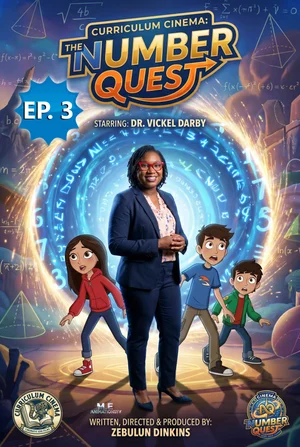
Episode 3: “The Fraction Kingdom” (fractions)
After escaping the deadly Multiplication Maze, Maya, Jordan, and Leo travel to the mysterious Fraction Kingdom, where rivers, bridges, and entire cities are powered by magical fraction crystals. But when Dr. Chaos corrupts the kingdom’s balance, fractions begin splitting apart, causing buildings to crumble and pathways to disappear. To restore order, the heroes must master equivalent fractions, mixed numbers, improper fractions, fraction comparison, and operations with fractions and decimals. Along the way, they solve real-world challenges involving sharing, graphing data, and probability while navigating dangerous fraction puzzles and illusion-filled landscapes. Inside the kingdom’s towering Fraction Castle, the team discovers that the final Crystal Fragment has been locked behind the powerful “Balance Gate,” which can only be opened by proving that different fractions can represent the same value. As Dr. Chaos unleashes his terrifying Decimal Dragon, the heroes must combine all their math skills to save Fraction Kingdom before it collapses into numerical chaos forever. STANDARDS: 4.PAFR.1.2 4.PAFR.1.3 4.PAFR.1.4 4.PAFR.3.2 4.PAFR.3.4, 4.NR.2.3 4.NR.2.5 4.NR.2.6✅ Equivalent fractions ✅ Improper fractions & mixed numbers ✅ Comparing fractions ✅ Fraction addition/subtraction ✅ Fraction & decimal equivalencies ✅ Multiplying whole numbers by fractions ✅ Fractions as division ✅ Graph interpretation ✅ Probability concepts
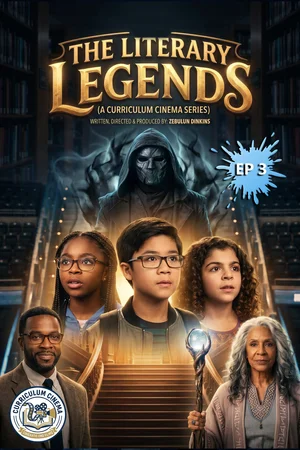
Episode 3: The Truth Seekers’ Summit
When the Eraser unleashes the Fog of Misinformation, Maya, Jordan, and Ava journey to the Summit of Truth. They must investigate questions, evaluate sources, analyze perspectives, identify rhetorical techniques, and present evidence-based conclusions. Their ability to think critically and communicate research findings becomes the only way to restore truth.
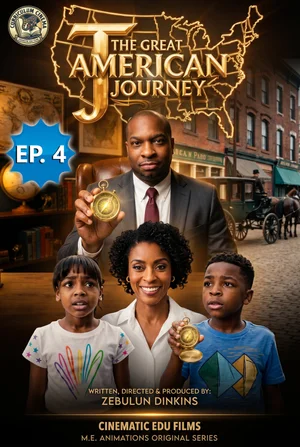
Episode 4: Social Changes
Maya and Jaden travel through the years following World War II, a time when the United States and the Soviet Union became rivals in a global struggle known as the Cold War. As they explore both capitalist America and communist Soviet society, they learn how different political and economic systems shaped people’s lives and created tension around the world. Their journey takes them into the Space Race, where technological competition pushed America and the Soviet Union to achieve major scientific breakthroughs. Along the way, Maya and Jaden witness how Cold War conflicts influenced wars in Korea and Vietnam and increased fears of nuclear war. Back home in the United States and South Carolina, the students experience major social changes during the Civil Rights Movement. They meet students fighting against segregation and learn how important court cases like Briggs v. Elliott and Brown v. Board of Education challenged unequal schools. Maya and Jaden also discover how African Americans, women, Chicano activists, and Native Americans worked to gain equal rights and opportunities. By the end of their adventure, the students understand how the Cold War, social movements, and the fight for equality transformed America between 1950 and 1980.
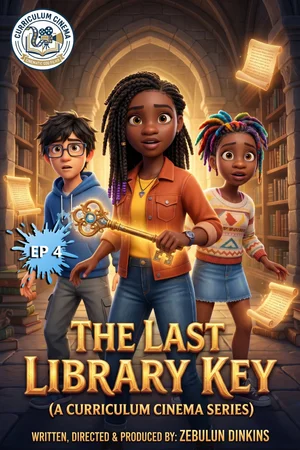
EPISODE 4: THE VOICES OF TRUTH
A mysterious force known as The Echo spreads confusion throughout The Archive by broadcasting conflicting messages through news reports, podcasts, interviews, and speeches. To save communication itself, the students must become effective listeners, speakers, and collaborators.
EPISODE 3: THE ATLANTIC STORM
The crew enters the Age of Exploration, where The Divider seeks to erase the connections that formed the Atlantic World. From the invention of the printing press to the Columbian Exchange, the Transatlantic Slave Trade, and the Enlightenment, Ava and her friends explore both the opportunities and hardships that transformed Europe, Africa, and the Americas.
EPISODE 2: "THE FUNCTION FLOW"
The crew advances to Functions City, where every building and beat follows mathematical patterns. To save the city's music network, Marcus and his friends must learn how functions work, analyze linear relationships, model exponential growth, and compare different types of functions. Through social media trends, music streaming data, and rap competitions, they discover how mathematical patterns help predict success.
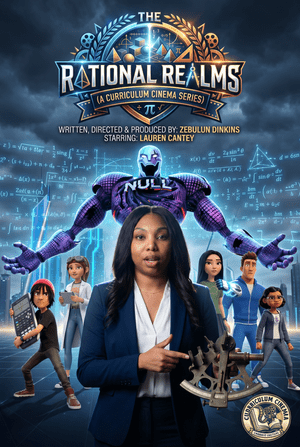
THE RATIONAL REALMS
A team of six middle-school heroes is transported into a digital universe called the Rational Realms after a mysterious math core begins malfunctioning. The only way to restore balance is by mastering integers, fractions, decimals, percentages, ratios, graphing, and rational numbers. Each realm presents dangerous puzzles, villains, and real-world missions where math becomes the key to survival.
EPISODE 3: THE EDITING CODE
The Archive's Editing Engine becomes corrupted, causing writing throughout the library to fall apart. Sentences lose punctuation, grammar breaks down, and publishing systems fail. The students must revise, edit, and rewrite documents to restore clear communication.
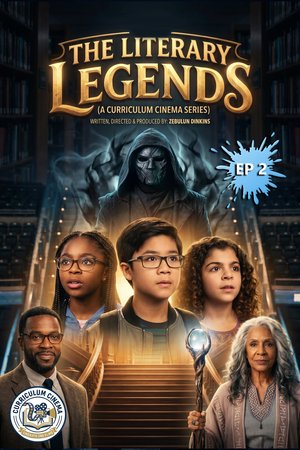
Episode 2: The Lost Writers’ Guild
After the Great Quill of Knowledge is stolen, the heroes travel to the City of Writers. There they complete challenges involving argumentative, informative, and narrative writing while learning the importance of revision, research, inquiry, and effective communication. Their writing skills become the key to restoring creativity and knowledge.
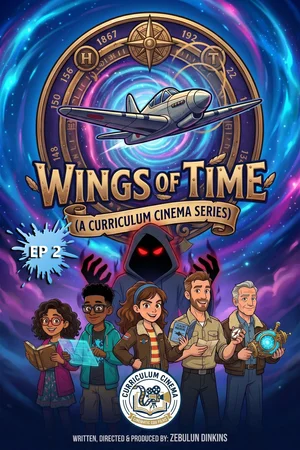
EPISODE 2: SKIES OF EMPIRES
The Divider attempts to separate civilizations from one another by erasing trade routes and cultural exchanges. The Chrono Flyer travels to medieval Europe, the Islamic world, Mongol territories, West Africa, and the Americas, revealing how trade, migration, and shared ideas connected societies across continents.
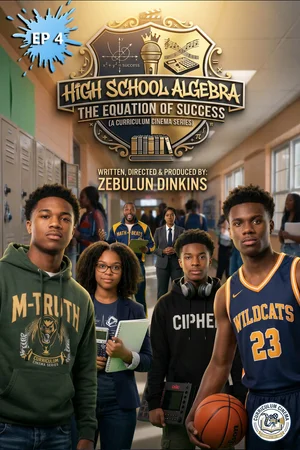
Episode 4 (Season Finale): "THE DATA DYNASTY"
The championship round of the Hip-Hop Innovation Contest has finally arrived. Marcus, Kayla, Rico, and DJ Cipher must face the undefeated team from Tech City Academy in the ultimate battle for a $100,000 scholarship and a national music technology contract. The contest takes place inside Data Dome, a massive futuristic arena powered entirely by statistics, probability, and artificial intelligence. The championship's supercomputer, known as "The Oracle," predicts that Eastside High has only a 12% chance of winning. To prove The Oracle wrong, the team must collect data, analyze trends, calculate probabilities, and make critical decisions based on evidence rather than guesses. The fate of Eastside High—and the championship—depends on mastering the power of data.
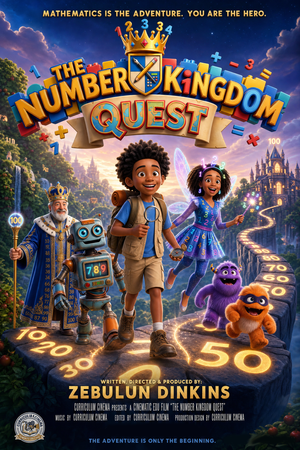
THE NUMBER KINGDOM QUEST
When the Missing Number Bandits scatter numbers throughout the Number Kingdom, Milo, Nova, and Count Bot must recover them by counting, comparing quantities, identifying positions, and building teen numbers. Along the way, they learn the foundations of number sense and save the kingdom.
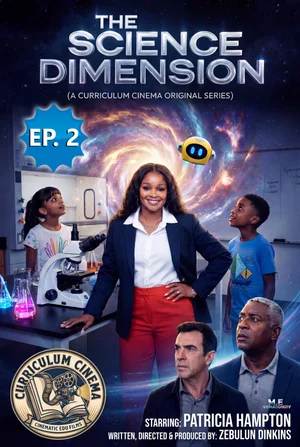
Episode 2: WAVE RUNNERS: SIGNALS OF THE FUTURE (Energy PS4)
Wave Runners: Signals of the Future Brief Synopsis: When the mysterious villain Dr. Static shuts down all communication systems in the city, young science explorers Maya and Jayden must team up with their mentor Professor Watts and their AI companion Spark to restore the signals before chaos takes over. Along their journey, they investigate how waves work by exploring ripples in water, modeling amplitude and wavelength, discovering how sound waves can move objects, and learning how reflected light allows us to see. To defeat Dr. Static, the team must solve a series of communication challenges using patterns like drum beats, flashlight signals, and binary code to transmit information across long distances. Packed with adventure, humor, and hands-on science discovery, Wave Runners: Signals of the Future transforms fourth-grade wave and information transfer standards into an exciting cinematic STEM experience where science becomes the key to saving the city. STANDARDS: ⚡ 4-PS3-1 Relating Speed and Energy Students use evidence to explain that faster-moving objects have more energy. Covered In: Skateboard investigation Rolling boulder scene ⚡ 4-PS3-2 Energy Transfer Students observe energy transferring through: Sound Light Heat Electric currents Covered In: Sound Cave Light Forest Heat Chamber Electric Grid ⚡ 4-PS3-4 Designing Energy-Converting Devices Students design, test, and improve a device that converts energy from one form to another. Covered In: Invention Chamber engineering challenge
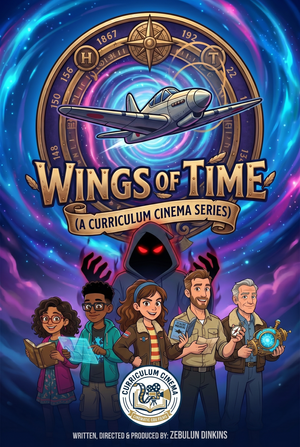
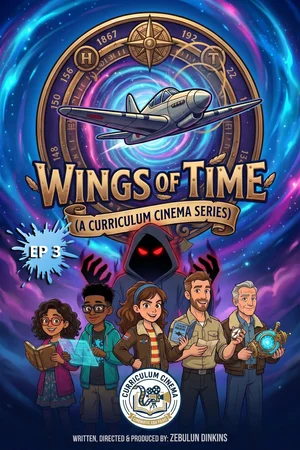
WINGS OF TIME
After their incredible journey through ancient civilizations, young pilot Ava Reynolds and her friends discover that the mysterious Chrono Flyer has a new mission. A dangerous time thief known as The Divider is attempting to separate civilizations from one another, erasing centuries of trade, cultural exchange, exploration, and innovation. To save history, Ava and her crew must fly across medieval kingdoms, Mongol territories, Crusader battlefields, West African trade routes, and the great civilizations of the Americas. As they race across continents, they discover that civilizations grew stronger through connection, exchange, and shared ideas.
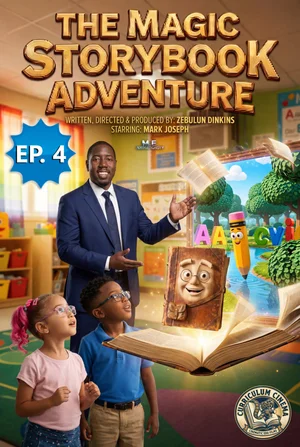
Episode 4: “THE REALM OF HIDDEN MEANINGS” (THE GREAT STORYBOOK ADVENTURE)
When mysterious shadows begin erasing stories from the magical library, Mia and Max must journey into the Realm of Hidden Meanings — a world where themes, perspectives, figurative language, and text structures come alive. Guided by Mr. Pages and Mr. Lane, the friends travel through dramatic kingdoms, poetic forests, and informational cities to uncover how authors use conflict, setting, point of view, evidence, and literary techniques to shape meaning. Along the way, Mia and Max discover that stories are more than words on a page — they are windows into ideas, emotions, and perspectives. STANDARDS COVERED ELA.AOR.1 ELA.4.AOR.1.1 Explain how setting and conflict change characters Explain how conflict develops plot ELA.4.AOR.1.2 Explain figurative language including: similes metaphors hyperbole imagery personification idioms alliteration onomatopoeia ELA.AOR.2 ELA.4.AOR.2.1 Identify explicit and implied themes Explain how themes develop through details ELA.4.AOR.2.2 Identify central ideas in informational texts Explain supporting details ELA.AOR.3 ELA.4.AOR.3.1 Compare first-person and third-person narration Explain how character perspectives impact stories ELA.AOR.4 ELA.4.AOR.4.1 Explain author’s purpose and perspective ELA.AOR.5 ELA.4.AOR.5.1 Compare narratives, dramas, and poems ELA.4.AOR.5.2 Identify informational text structures: problem/solution chronological compare/contrast ELA.4.AOR.5.3 Explain reasons and evidence supporting claims
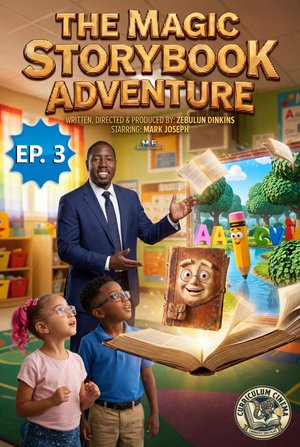
Episode 3: THE GREAT STORYBOOK ADVENTURE
In Episode 3, “The Great Writing Quest,” Mia and Max are transported back into the magical world of stories when the powerful Book of Ideas begins losing its pages. Guided by Mr. Pages and Quilla the Feather Pen, the friends journey through Opinion Village, Information Island, and Narrative Mountain to learn the secrets of strong writing. Along the way, they practice writing opinion pieces with supporting reasons, informative texts with facts and details, and exciting narratives with clear plot structure, characters, settings, and endings. Through teamwork and creativity, Mia and Max discover that writing gives life to ideas and imagination. Standards Covered Written and Oral Communications (C) ELA.C.1 – Opinion Writing ELA.3.C.1.1 Students learn to: Write opinion pieces about a topic Introduce a topic clearly State an opinion Support opinions with reasons and details Use transition words to connect ideas Organize information logically Provide a concluding statement ELA.C.2 – Informative/Explanatory Writing ELA.3.C.2.1 Students learn to: Introduce and explain a topic Use facts, definitions, and details Organize information into groups Use grade-appropriate transitions Use precise vocabulary Explain information from a provided source Write a concluding statement ELA.C.3 – Narrative Writing ELA.3.C.3.1 Students learn to: Establish a setting and characters Sequence events using temporal words and phrases Describe actions, thoughts, and feelings Develop narrative plot structure including: exposition rising action climax falling action conclusion Provide a satisfying ending
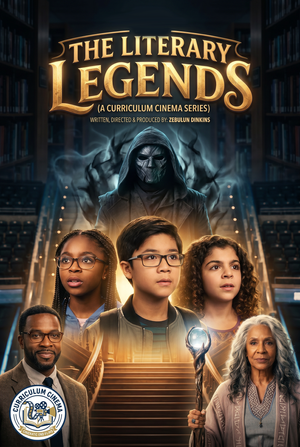
THE LITERARY LEGENDS
A four-part educational adventure series that follows Maya, Jordan, and Ava as they journey through magical worlds where literacy skills become the key to saving knowledge, stories, research, and communication. Each episode focuses on specific South Carolina ELA standards while building students' reading, writing, speaking, listening, and inquiry skills.
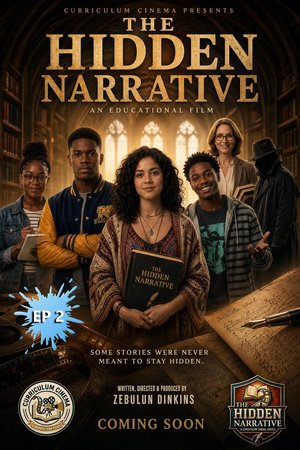
EPISODE 2: THE LOST CHAPTERS
The students discover missing chapters hidden throughout the school. As they piece together clues, they learn how flashbacks, foreshadowing, informational text structures, arguments, vocabulary, and context clues help readers uncover deeper meanings and build suspense.
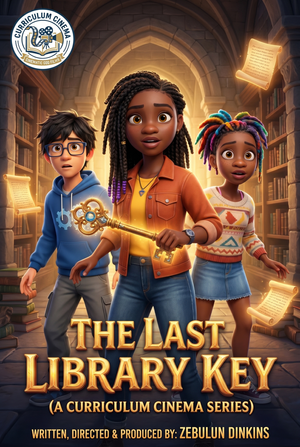
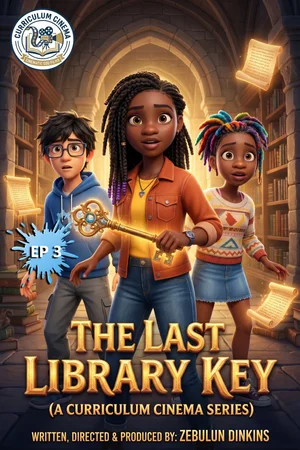
THE LAST LIBRARY KEY
When a mysterious key appears inside an ancient library book, three seventh graders discover a hidden chamber beneath their school. Inside lies "The Archive," a magical vault containing stories, historical documents, news reports, journals, and forgotten knowledge from across time. To prevent a powerful tech billionaire from rewriting history, the students must analyze literary texts, evaluate evidence, research historical mysteries, identify credible sources, and uncover the truth hidden within conflicting accounts. Every clue requires real ELA skills, and every answer brings them closer to unlocking the final secret of The Archive.
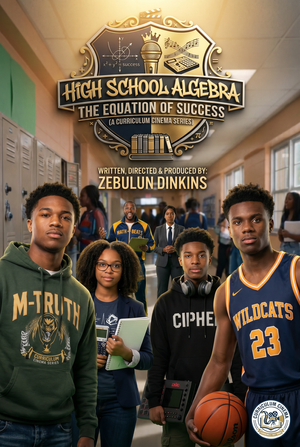
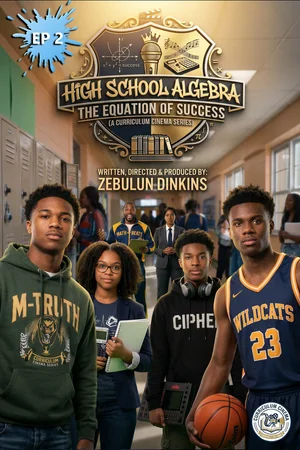
HIGH SCHOOL ALGEBRA: THE EQUATION OF SUCCESS
At Eastside High School, aspiring music producer Marcus "M-Truth" Johnson and his friends discover that mathematics is the key to winning the city's prestigious Hip-Hop Innovation Contest. Guided by the energetic Coach Numbers, the crew travels through futuristic cities where algebra powers music, technology, sports, and business. Along the way, they master real numbers, functions, polynomials, and quadratics while overcoming rivals, solving challenges, and learning that education can unlock their dreams.
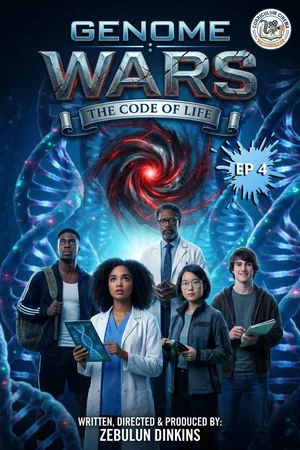
Episode 4: The Timekeepers of Evolution
When a rogue AI known as The Rewriter begins erasing Earth's evolutionary history, Maya and her friends must travel through fossil records, ancient ecosystems, and evolutionary timelines to restore the Chronos Core. By examining fossils, comparing ancient and modern organisms, studying natural selection, and exploring genetic technologies, the students learn how life has changed over millions of years and how diversity drives survival.
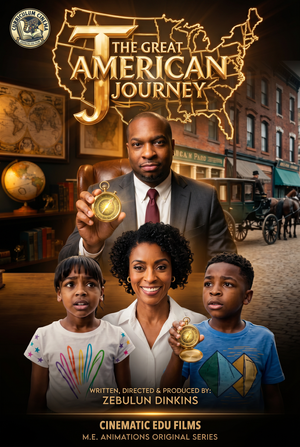
THE TRANSCONTINENTAL RAILROAD
Maya and Jaden think history is boring—until their teacher introduces a magical compass named Spark that transports them back to America during the late 1800s. As they travel across the country, they witness the construction of the Transcontinental Railroad and see how it transformed the American landscape, connected the East and West, and encouraged migration and settlement. Along the way, they meet immigrant families seeking opportunity in America and learn about the push and pull factors that brought millions of people to the United States. Their adventure continues through booming industrial cities during the Second Industrial Revolution, where factories, steel, railroads, and new inventions changed everyday life and increased America’s need for raw materials. Finally, Maya and Jaden experience the Spanish-American War and discover how the United States expanded its influence overseas, becoming a growing world power. Through their journey, the students learn how expansion, immigration, industrialization, and imperialism shaped both the United States and South Carolina. Standards Covered Standard 1: Demonstrate an understanding of the economic, political, and social effects of expansion and industrialization on the United States and South Carolina between 1860–1910. Enduring Understanding: The Second Industrial Revolution, urbanization, and access to resources contributed to the expansion of the United States during this period. At the same time, migration into and within the country created challenges, opportunities, and cultural diversity. Specific Standards Covered 5.1.CO Compare the physical landscape and demographics of the United States before and after the Transcontinental Railroad. 5.1.CE Examine push and pull factors related to immigration and expansion on urban and rural populations during the period. 5.1.P Summarize how the United States’ involvement in the Spanish-American War led to increased economic expansion and imperialism. 5.1.CX Contextualize how the Second Industrial Revolution increased the demand for raw materials and contributed to U.S. economic expansion and imperialism.
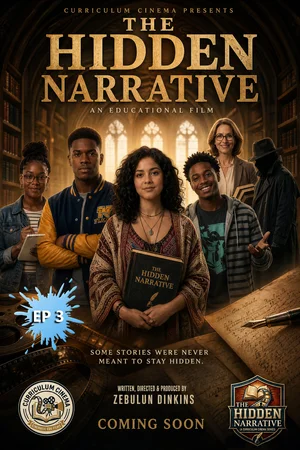
EPISODE 3: THE VOICE BETWEEN THE LINES
The investigation expands beyond the manuscript as students analyze figurative language, connotation, denotation, etymology, and multimedia sources. They must determine which sources are credible while uncovering new clues hidden in videos, newspapers, photographs, and digital archives.
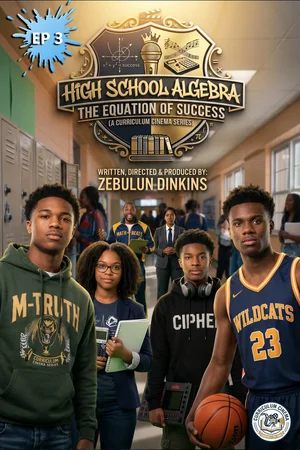
EPISODE 3: "THE POLYNOMIAL PLAYOFF"
The semifinals take place in Polynomial Park, where a mysterious hacker called The Factor threatens to shut down the competition. To save the city, Marcus and his friends must add, subtract, and multiply polynomials, factor expressions, solve quadratic equations, and graph parabolas. Through music battles and sports challenges, they learn how breaking complex problems into smaller pieces leads to success.
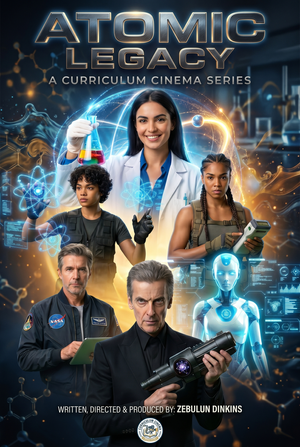
ATOMIC LEGACY
In the series premiere, a group of young science explorers uncovers a mysterious atomic research journal that transports them through key moments in the history of atomic science. As they meet groundbreaking scientists and witness the discoveries that revealed the structure of matter, they learn how atoms became the foundation of modern chemistry, physics, medicine, and technology. The episode explores atomic structure, protons, neutrons, electrons, isotopes, and the development of the atomic model while emphasizing how scientific discoveries build upon one another over time. The concepts align with foundational atomic science instruction commonly used in chemistry education.
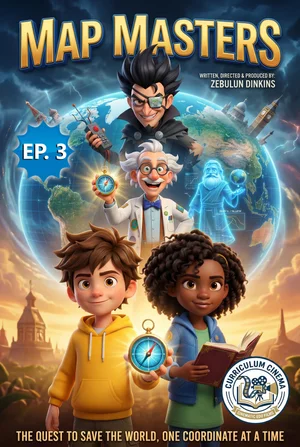
EPISODE 3: THE WORLD OF CULTURES
When Captain Chaos steals the Cultural Compass, Earth's traditions begin disappearing. Jayden and Mia travel around the world exploring cultural celebrations, community types, and economic systems while restoring the colorful diversity that makes every culture unique.
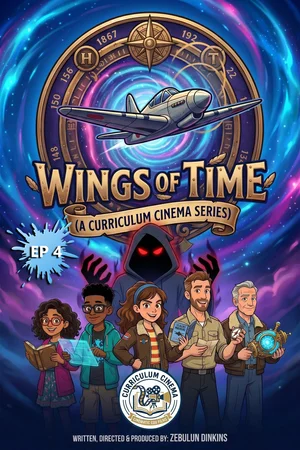
EPISODE 4: ONE WORLD, ONE SKY
In the series finale, The Divider launches a final attack on the interconnected modern world. The Chrono Flyer travels through the Great Depression, World War II, the Civil Rights Movement, the Cold War, the Digital Revolution, and modern sustainability initiatives. The crew discovers that cooperation, communication, and innovation have made the world more connected than ever before.
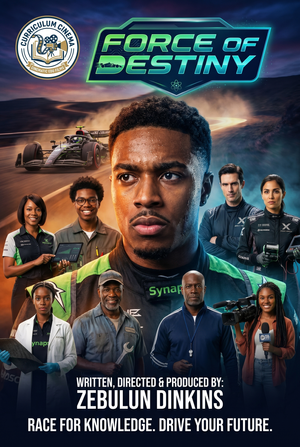
FORCE OF DESTINY
Rising Formula 1 star Malik Johnson dreams of becoming the world's fastest driver, but winning races requires more than talent—it requires understanding the science of motion. When a dangerous crash during a championship qualifying event forces teams to rethink performance and safety, Malik and his engineers investigate the physics behind acceleration, momentum, collisions, gravity, electricity, and advanced racing materials. Guided by Dr. Simone Carter and a team of brilliant STEM experts, Malik learns how Newton's Laws of Motion, conservation of momentum, collision engineering, electromagnetism, and materials science influence every aspect of racing. As rival champion Victor Kane gains an early advantage, Malik must apply science and engineering principles both on and off the track to compete for victory. Filled with high-speed racing, cutting-edge technology, and real-world physics, Episode 1 introduces the scientific forces that power the world of Formula 1 while showing how STEM innovation can turn challenges into opportunities for success. Featured Concepts: Newton's Second Law, Momentum Conservation, Collision Safety, Gravitation, Electromagnetic Forces, and Advanced Materials Science. 🏎️⚡🏁
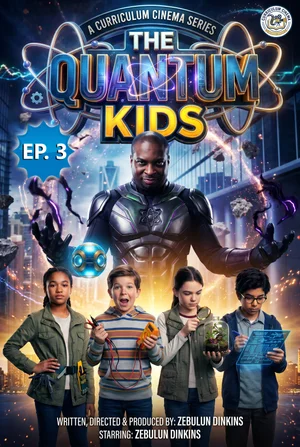
Episode 3: “THE STARLIGHT PARADOX”
When strange flashes of light begin appearing across the galaxy, the Quantum Kids discover a mysterious “Starlight Rift” that bends time, space, and energy. As the crew travels through a glowing nebula, they encounter a cosmic paradox where events seem to happen before they begin. To solve the mystery, the team must learn about quantum entanglement, light waves, energy transfer, gravity, and the behavior of particles in space.
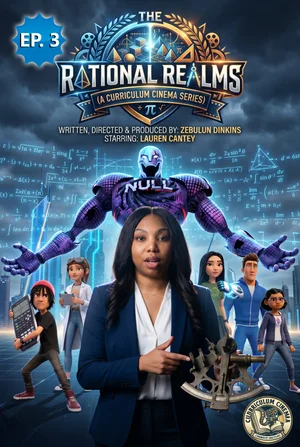
Episode 3: “THE PROBABILITY PARADOX”
After repairing the Equation Engine, the heroes detect strange distortions spreading through the Rational Realms. Entire cities are becoming unpredictable as probability systems fail and data streams become corrupted. The team travels to the Data Nexus — a futuristic city powered by statistics, probability, and predictive algorithms. There, Lord Null unleashes chaos by manipulating outcomes, altering graphs, and breaking the laws of chance itself. To save the realm, the students must analyze data sets, interpret box plots, calculate median and mode, and use probability to predict dangerous outcomes before reality collapses.
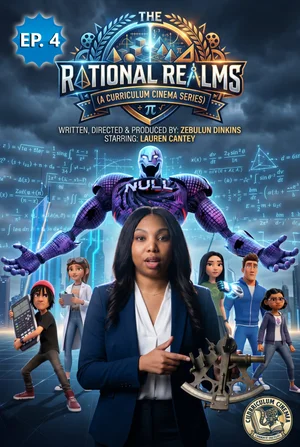
Episode 4: “THE GEOMETRY CODE”
The heroes journey into GeoCore City, a massive realm constructed entirely from geometric structures, floating polygons, and colossal three-dimensional shapes. But when Lord Null infects the Geometry Core, buildings begin collapsing, dimensions distort, and entire structures fold into impossible shapes. To restore balance, the team must master area, surface area, volume, angles, nets, composite figures, and coordinate graphing before the entire Rational Realms folds in on itself. Meanwhile, the hidden Prime Code grows stronger beneath the planet.
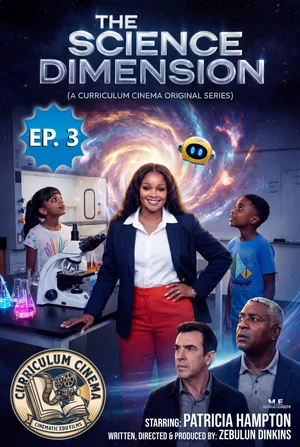
Episode 3: BioCore – Secrets of Survival
When plants across the city begin wilting overnight and animals start behaving strangely, Maya, Jayden, Professor Watts, and Spark discover that the mysterious villain Dr. Venom has activated the powerful BioCore Disruptor, a machine capable of interfering with the living systems organisms need to survive. To stop the growing ecological disaster, the team journeys through dangerous biodomes, underground research labs, and sensory mazes to uncover how plants and animals depend on internal and external structures working together as systems. Along the way, they investigate roots, thorns, lungs, hearts, skin, and camouflage while learning how organisms grow, survive, protect themselves, and reproduce. As Dr. Venom unleashes traps that confuse the senses of both humans and animals, Maya and Jayden must also model how living things receive information through sight, sound, touch, and other senses, process it in the brain, and respond to the world around them. Using evidence, teamwork, and scientific reasoning, the team races to restore balance before the city’s living systems completely collapse. 📘 Standards Covered 4-LS1-1: Plant and animal structures function together in systems 4-LS1-2: Animals receive, process, and respond to sensory information
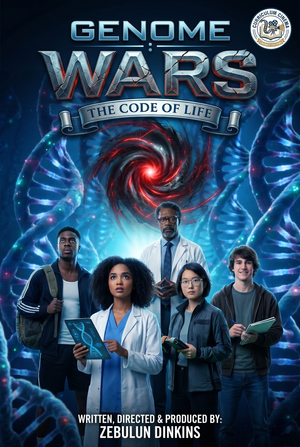
GENOME WARS
When Maya Carter and her classmates are accidentally transported inside a living human body, they discover a rogue AI called The Mutator that is corrupting DNA and disrupting biological systems. To save the body and return home, they must journey through cells, chromosomes, organs, and energy-producing structures while learning how DNA directs protein synthesis, how cells divide, how body systems function, and how organisms obtain and use energy.
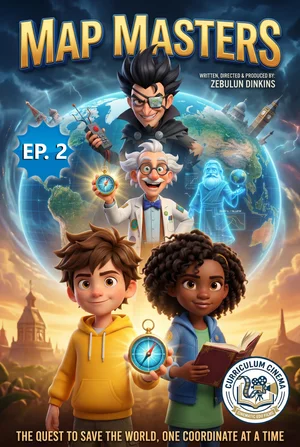
EPISODE 2: THE GREAT JOURNEYS
The Journey Lines of history are disappearing. Jayden and Mia travel across time and around the world to discover why people explore and migrate. Along the way they meet famous explorers, inventors, leaders, and freedom seekers whose journeys changed history.
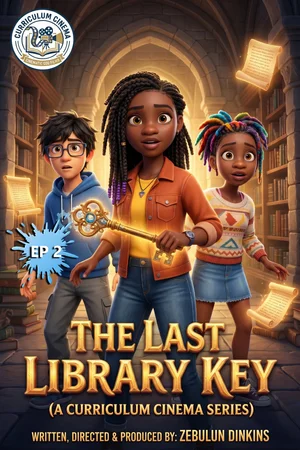
EPISODE 2: THE WRITER'S CHALLENGE
When the magical Writer's Quill is stolen, arguments lose evidence, informational texts lose facts, and stories lose their plots. Zuri, Kai, and Nia must complete a series of writing challenges to restore balance to The Archive and recover the stolen artifact.
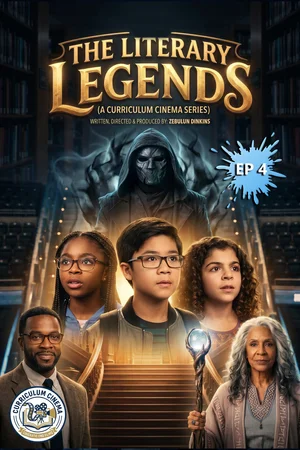
Episode 4: The Council of Voices (Season Finale)
In the epic season finale, the Eraser launches his final attack by destroying communication itself. Maya, Jordan, and Ava must unite the Council of Voices by helping them collaborate, respect diverse perspectives, evaluate arguments, and listen effectively. Together they learn that the strongest solutions come from thoughtful discussion and shared understanding.
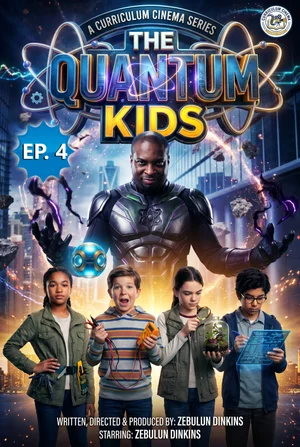
Episode 4: “PLANET IN PERIL”
When violent storms, earthquakes, and rising oceans begin threatening Nova Springs, the Quantum Kids discover that Dr. Void is disrupting Earth’s natural systems. Traveling through volcanic caves, floating cloud cities, and endangered coastlines, the team learns how the geosphere, hydrosphere, atmosphere, and biosphere work together to support life on Earth. Along the way, they explore the rock cycle, water cycle, Earth’s freshwater supply, and ways communities can protect the environment. To save the planet, the team must restore balance before Earth’s systems collapse completely.
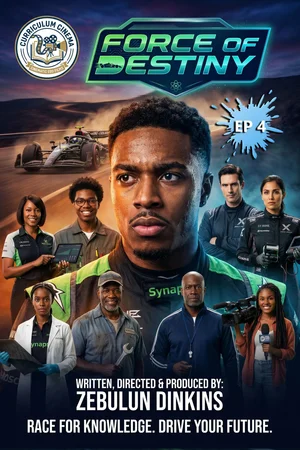
Episode 4: THE RISING CHAMPION
With the Formula 1 World Championship tied between rising star Malik Johnson and rival champion Victor Kane, everything comes down to one final race on the most challenging circuit ever designed. Featuring extreme curves, powerful crosswinds, steep elevation changes, and unpredictable weather, the championship track becomes the ultimate test of science, engineering, and skill. As Malik and his team prepare for the race, they encounter a series of technical challenges involving rotational motion, centripetal force, aerodynamics, fluid dynamics, pressure, torque, and thermodynamics. Guided by Dr. Simone Carter, Jaden Brooks, and Dr. Amina Reed, Malik must apply everything he has learned throughout the season to refine the race car and develop winning strategies. When dangerous weather threatens the championship and Victor unveils one final technological advantage, Malik discovers that success is not determined by speed alone but by understanding how physics governs every movement on and off the track. In a thrilling winner-take-all finale, science, perseverance, and teamwork collide as Malik races toward his destiny and inspires a new generation of future engineers and scientists.
SCIENCE (3rd-5th Grade)
4 Videos
THE SCIENCE DIMENSION
Episode 1 Synopsis: “The Ripple Effect” Ten-year-old science lovers Maya Johnson and Jayden Carter are excited to present their newest invention at the school STEM showcase when a strange citywide glitch suddenly shuts down phones, computers, traffic lights, and communication systems. The source is revealed to be the mysterious villain Dr. Static, who has launched a device that scrambles all signals across the city. With help from their brilliant mentor Professor Watts and floating AI assistant Spark, Maya and Jayden begin a mission to understand the science behind waves and communication. Starting with simple ripples in a pond, they discover that waves are repeating patterns of motion with different heights (amplitude) and spacing (wavelength), and that waves can even cause objects to move. As the team follows clues through a mirror maze, sound chamber, and signal tower, they learn how light reflection helps us see objects and how patterns like drum beats, flashlight signals, and binary code can be used to send messages over long distances. In the final showdown, Maya and Jayden must use everything they’ve learned about waves, light, and coding patterns to restore the city’s communication network before Dr. Static permanently disconnects the world. Disciplinary Core Ideas (DCIs) ✔ PS3.A – Definitions of Energy Speed relates to energy ✔ PS3.B – Conservation of Energy and Energy Transfer Energy transferred through sound, light, heat, and electricity ✔ PS3.D – Energy in Chemical Processes and Everyday Life Stored energy in batteries converted for practical use ✔ ETS1.A – Defining Engineering Problems Designing within constraints
Episode 2: WAVE RUNNERS: SIGNALS OF THE FUTURE (Energy PS4)
Wave Runners: Signals of the Future Brief Synopsis: When the mysterious villain Dr. Static shuts down all communication systems in the city, young science explorers Maya and Jayden must team up with their mentor Professor Watts and their AI companion Spark to restore the signals before chaos takes over. Along their journey, they investigate how waves work by exploring ripples in water, modeling amplitude and wavelength, discovering how sound waves can move objects, and learning how reflected light allows us to see. To defeat Dr. Static, the team must solve a series of communication challenges using patterns like drum beats, flashlight signals, and binary code to transmit information across long distances. Packed with adventure, humor, and hands-on science discovery, Wave Runners: Signals of the Future transforms fourth-grade wave and information transfer standards into an exciting cinematic STEM experience where science becomes the key to saving the city. STANDARDS: ⚡ 4-PS3-1 Relating Speed and Energy Students use evidence to explain that faster-moving objects have more energy. Covered In: Skateboard investigation Rolling boulder scene ⚡ 4-PS3-2 Energy Transfer Students observe energy transferring through: Sound Light Heat Electric currents Covered In: Sound Cave Light Forest Heat Chamber Electric Grid ⚡ 4-PS3-4 Designing Energy-Converting Devices Students design, test, and improve a device that converts energy from one form to another. Covered In: Invention Chamber engineering challenge
Episode 3: BioCore – Secrets of Survival
When plants across the city begin wilting overnight and animals start behaving strangely, Maya, Jayden, Professor Watts, and Spark discover that the mysterious villain Dr. Venom has activated the powerful BioCore Disruptor, a machine capable of interfering with the living systems organisms need to survive. To stop the growing ecological disaster, the team journeys through dangerous biodomes, underground research labs, and sensory mazes to uncover how plants and animals depend on internal and external structures working together as systems. Along the way, they investigate roots, thorns, lungs, hearts, skin, and camouflage while learning how organisms grow, survive, protect themselves, and reproduce. As Dr. Venom unleashes traps that confuse the senses of both humans and animals, Maya and Jayden must also model how living things receive information through sight, sound, touch, and other senses, process it in the brain, and respond to the world around them. Using evidence, teamwork, and scientific reasoning, the team races to restore balance before the city’s living systems completely collapse. 📘 Standards Covered 4-LS1-1: Plant and animal structures function together in systems 4-LS1-2: Animals receive, process, and respond to sensory information
Episode 4: Earthbreakers – Secrets Beneath the Surface
When powerful earthquakes, floods, and violent storms suddenly begin tearing through the region, Maya, Jayden, Professor Watts, and Spark uncover the existence of the ancient TerraCore, a hidden machine capable of accelerating Earth’s natural processes. Behind the chaos is the dangerous scientist Dr. Rift, who plans to reshape the planet using the destructive power of Earth itself. To stop him, the team must investigate fossils, rock layers, canyons, erosion, volcanoes, and earthquake zones to uncover clues about how Earth has changed over time. As they explore collapsing caves, raging rivers, and underground chambers, they learn how water, wind, ice, and vegetation continuously shape the landscape. Using maps, scientific evidence, and engineering design, Maya and Jayden race to create solutions that can protect the city from natural disasters before the TerraCore triggers catastrophic destruction across the planet. 📘 Standards Covered 4-ESS1-1: Fossils and rock layers reveal Earth’s history 4-ESS2-1: Weathering and erosion shape Earth’s surface 4-ESS2-2: Earth’s features occur in patterns on maps 4-ESS3-1: Natural resources and energy affect the environment 4-ESS3-2: Engineering solutions reduce impacts of natural hazards
MATH (3rd-5th Grade)
4 Videos
THE NUMBER QUEST
When a mysterious villain named Dr. Chaos steals the magical Number Crystal from Math Kingdom, numbers across the land become scrambled. Three young heroes—Maya, Jordan, and Leo—must travel through Place Value Mountain, Estimate Valley, and Addition Fortress to restore order. Along the way, they solve real-world math challenges involving ordering numbers, comparing values, rounding, estimating sums and differences, and solving addition/subtraction problems up to 100,000. If they fail, all math in the kingdom will disappear forever.
Episode 2: The Multiplication Maze:
Maya, Jordan, and Leo journey into the dangerous Multiplication Maze after Dr. Chaos hides the second Crystal Fragment deep inside its shifting walls. To survive, the team must solve challenges involving factor pairs, prime and composite numbers, multiplication, division, patterns, and algebraic equations. As giant robot guardians, collapsing bridges, and changing tunnels block their path, the heroes discover that every part of the maze follows mathematical rules and patterns. Using teamwork and problem-solving skills, they battle Dr. Chaos’s Equation Beasts and solve real-world two-step problems to unlock the Crystal Chamber. But just as they recover the fragment, Dr. Chaos unveils his terrifying new invention — the Equation Storm Engine — a machine powerful enough to erase math from the kingdom forever. STANDARDS COVERED: 4.PAFR.3.1 4.PAFR.3.2 4.PAFR.3.3 4.PAFR.3.4 4.PAFR.1.2 4.PAFR.1.3 4.PAFR.1.4 4.PAFR.3.2 4.PAFR.3.4
Episode 3: “The Fraction Kingdom” (fractions)
After escaping the deadly Multiplication Maze, Maya, Jordan, and Leo travel to the mysterious Fraction Kingdom, where rivers, bridges, and entire cities are powered by magical fraction crystals. But when Dr. Chaos corrupts the kingdom’s balance, fractions begin splitting apart, causing buildings to crumble and pathways to disappear. To restore order, the heroes must master equivalent fractions, mixed numbers, improper fractions, fraction comparison, and operations with fractions and decimals. Along the way, they solve real-world challenges involving sharing, graphing data, and probability while navigating dangerous fraction puzzles and illusion-filled landscapes. Inside the kingdom’s towering Fraction Castle, the team discovers that the final Crystal Fragment has been locked behind the powerful “Balance Gate,” which can only be opened by proving that different fractions can represent the same value. As Dr. Chaos unleashes his terrifying Decimal Dragon, the heroes must combine all their math skills to save Fraction Kingdom before it collapses into numerical chaos forever. STANDARDS: 4.PAFR.1.2 4.PAFR.1.3 4.PAFR.1.4 4.PAFR.3.2 4.PAFR.3.4, 4.NR.2.3 4.NR.2.5 4.NR.2.6✅ Equivalent fractions ✅ Improper fractions & mixed numbers ✅ Comparing fractions ✅ Fraction addition/subtraction ✅ Fraction & decimal equivalencies ✅ Multiplying whole numbers by fractions ✅ Fractions as division ✅ Graph interpretation ✅ Probability concepts
Episode 4: “The Decimal Dimension” (Decimals)
After recovering the Fraction Crystal, Maya, Jordan, and Leo are pulled into the futuristic Decimal Dimension, a high-tech world controlled by Dr. Chaos and his giant mechanical decimal monster. Inside the glowing city of numbers, the heroes must use their understanding of decimals, measurements, geometry, money, time, area, and perimeter to survive dangerous puzzles and restore balance to Math Kingdom. As collapsing streets, giant measurement labs, and shape-powered fortresses stand in their way, the team learns how fractions and decimals are connected while solving real-world problems involving elapsed time, unit conversions, purchases, and geometric classifications. In the final showdown, the heroes battle Dr. Chaos inside the massive Decimal Core, where one wrong decimal comparison could destroy math forever. Using teamwork and mathematical reasoning, they must stop the Equation Storm Engine before the entire kingdom is erased. STANDARDS:4.NR.2.1 4.NR.2.2, 4.MGSR.1.1 4.MGSR.1.2 4.MGSR.2.1 4.MGSR.2.2 4.MGSR.2.3 4.MGSR.2.4 4.MGSR.2.5, 4.MGSR.3.1 4.MGSR.3.2 ✅ Decimal notation ✅ Comparing decimals ✅ Fractions and decimals ✅ Area & perimeter ✅ Money calculations ✅ Elapsed time ✅ Measurement conversions ✅ Weight & length ✅ Triangle classification ✅ Quadrilateral hierarchy
ENGLISH I (High School)
4 Videos
THE HIDDEN NARRATIVE
Students Maya, Jordan, Olivia, and Marcus discover an anonymous manuscript hidden in the school library. As they begin reading, they analyze perspective, theme, figurative language, irony, and author purpose. Their investigation uncovers clues suggesting the story may be connected to real events from the school's past.
EPISODE 2: THE LOST CHAPTERS
The students discover missing chapters hidden throughout the school. As they piece together clues, they learn how flashbacks, foreshadowing, informational text structures, arguments, vocabulary, and context clues help readers uncover deeper meanings and build suspense.
EPISODE 3: THE VOICE BETWEEN THE LINES
The investigation expands beyond the manuscript as students analyze figurative language, connotation, denotation, etymology, and multimedia sources. They must determine which sources are credible while uncovering new clues hidden in videos, newspapers, photographs, and digital archives.
EPISODE 4: THE TRUTH IN INK (Finale)
The students finally uncover the truth behind the anonymous manuscript. To ensure the story is remembered, they must research, write arguments, create presentations, defend claims, address counterclaims, collaborate with peers, and present their findings to the school board in a dramatic final showdown of evidence and ideas.
ELA (Kindergarten-3rd Grade)
4 Videos
THE GREAT STORYBOOK ADVENTURE
THE MAGIC STORYBOOK ADVENTURE is a fun-filled educational fantasy film that follows two kindergarten friends, Mia and Max, as they are magically transported inside a living storybook by the mysterious Mr. Pages. Guided by their teacher, Mr. Lane, and magical friends along the way, the children journey through enchanted lands where they learn about characters, setting, plot, rhyming words, alliteration, onomatopoeia, informational texts, and the important roles of authors and illustrators. Through songs, challenges, and storytelling adventures, Mia and Max discover that every book holds a world of imagination and learning. Standards Covered ELA.AOR.1 ELA.K.AOR.1.1 Identify and describe main characters Identify setting Identify events that move the plot forward Understand problem and solution relationships Describe characters by: appearance feelings actions ELA.K.AOR.1.2 Identify figurative language including: alliteration onomatopoeia Recognize: descriptive words rhyming words ELA.AOR.2 ELA.K.AOR.2.1 Retell familiar stories using: characters setting beginning, middle, and end major events ELA.K.AOR.2.2 Retell informational texts by identifying: topic supporting details ELA.AOR.3 ELA.K.AOR.3.1 Identify the role of the author Identify the role of the illustrator Explain how words and pictures work together in stories
Episode 2: “THE FLUENCY FRONTIER” (THE GREAT STORYBOOK ADVENTURE)
After mastering basic story elements in Episode 1, Mia and Max return to the magical library where Mr. Pages introduces them to the Fluency Frontier — a fast-moving world where words come alive. To save the Story Train from losing its power, the friends must improve their reading fluency by decoding tricky words, using context clues, recognizing prefixes and suffixes, and reading with expression and accuracy. Along the way, they encounter magical metaphors, hilarious hyperboles, and silly idioms that challenge them to understand figurative language while discovering how characters grow throughout a story. STANDARDS: ELSCA.F.4: ELA.3.F.4.1 ELA.3.F.4.2 ELA.3.F.4.3 Applications of Reading (AOR) ELA.AOR.1: ELA.3.AOR.1.1 ELA.3.AOR.1.2 Indicator Insights: Evaluate and critique key literary elements that enhance and deepen meaning within and across texts. Explain how one or more characters develop throughout the plot. Identify and explain the purpose of forms of figurative language to include metaphor, hyperbole, and idioms.
Episode 3: THE GREAT STORYBOOK ADVENTURE
In Episode 3, “The Great Writing Quest,” Mia and Max are transported back into the magical world of stories when the powerful Book of Ideas begins losing its pages. Guided by Mr. Pages and Quilla the Feather Pen, the friends journey through Opinion Village, Information Island, and Narrative Mountain to learn the secrets of strong writing. Along the way, they practice writing opinion pieces with supporting reasons, informative texts with facts and details, and exciting narratives with clear plot structure, characters, settings, and endings. Through teamwork and creativity, Mia and Max discover that writing gives life to ideas and imagination. Standards Covered Written and Oral Communications (C) ELA.C.1 – Opinion Writing ELA.3.C.1.1 Students learn to: Write opinion pieces about a topic Introduce a topic clearly State an opinion Support opinions with reasons and details Use transition words to connect ideas Organize information logically Provide a concluding statement ELA.C.2 – Informative/Explanatory Writing ELA.3.C.2.1 Students learn to: Introduce and explain a topic Use facts, definitions, and details Organize information into groups Use grade-appropriate transitions Use precise vocabulary Explain information from a provided source Write a concluding statement ELA.C.3 – Narrative Writing ELA.3.C.3.1 Students learn to: Establish a setting and characters Sequence events using temporal words and phrases Describe actions, thoughts, and feelings Develop narrative plot structure including: exposition rising action climax falling action conclusion Provide a satisfying ending
Episode 4: “THE REALM OF HIDDEN MEANINGS” (THE GREAT STORYBOOK ADVENTURE)
When mysterious shadows begin erasing stories from the magical library, Mia and Max must journey into the Realm of Hidden Meanings — a world where themes, perspectives, figurative language, and text structures come alive. Guided by Mr. Pages and Mr. Lane, the friends travel through dramatic kingdoms, poetic forests, and informational cities to uncover how authors use conflict, setting, point of view, evidence, and literary techniques to shape meaning. Along the way, Mia and Max discover that stories are more than words on a page — they are windows into ideas, emotions, and perspectives. STANDARDS COVERED ELA.AOR.1 ELA.4.AOR.1.1 Explain how setting and conflict change characters Explain how conflict develops plot ELA.4.AOR.1.2 Explain figurative language including: similes metaphors hyperbole imagery personification idioms alliteration onomatopoeia ELA.AOR.2 ELA.4.AOR.2.1 Identify explicit and implied themes Explain how themes develop through details ELA.4.AOR.2.2 Identify central ideas in informational texts Explain supporting details ELA.AOR.3 ELA.4.AOR.3.1 Compare first-person and third-person narration Explain how character perspectives impact stories ELA.AOR.4 ELA.4.AOR.4.1 Explain author’s purpose and perspective ELA.AOR.5 ELA.4.AOR.5.1 Compare narratives, dramas, and poems ELA.4.AOR.5.2 Identify informational text structures: problem/solution chronological compare/contrast ELA.4.AOR.5.3 Explain reasons and evidence supporting claims
SOCIAL STUDIES (5th-6th Grade)
4 Videos
THE TRANSCONTINENTAL RAILROAD
Maya and Jaden think history is boring—until their teacher introduces a magical compass named Spark that transports them back to America during the late 1800s. As they travel across the country, they witness the construction of the Transcontinental Railroad and see how it transformed the American landscape, connected the East and West, and encouraged migration and settlement. Along the way, they meet immigrant families seeking opportunity in America and learn about the push and pull factors that brought millions of people to the United States. Their adventure continues through booming industrial cities during the Second Industrial Revolution, where factories, steel, railroads, and new inventions changed everyday life and increased America’s need for raw materials. Finally, Maya and Jaden experience the Spanish-American War and discover how the United States expanded its influence overseas, becoming a growing world power. Through their journey, the students learn how expansion, immigration, industrialization, and imperialism shaped both the United States and South Carolina. Standards Covered Standard 1: Demonstrate an understanding of the economic, political, and social effects of expansion and industrialization on the United States and South Carolina between 1860–1910. Enduring Understanding: The Second Industrial Revolution, urbanization, and access to resources contributed to the expansion of the United States during this period. At the same time, migration into and within the country created challenges, opportunities, and cultural diversity. Specific Standards Covered 5.1.CO Compare the physical landscape and demographics of the United States before and after the Transcontinental Railroad. 5.1.CE Examine push and pull factors related to immigration and expansion on urban and rural populations during the period. 5.1.P Summarize how the United States’ involvement in the Spanish-American War led to increased economic expansion and imperialism. 5.1.CX Contextualize how the Second Industrial Revolution increased the demand for raw materials and contributed to U.S. economic expansion and imperialism.
Episode 2: Federal Expansion
Brief Synopsis Maya and Jaden are swept back in time by the magical compass, Spark, to explore one of the most dramatic periods in American history between 1910 and 1940. Their journey begins in Europe during the rise of World War I, where they witness the tensions that pulled the United States into the conflict. From muddy trenches to patriotic rallies, they discover how war changed America politically and socially. Next, the students experience the excitement of the Roaring Twenties, where jazz music, new inventions, and the Harlem Renaissance transform American culture. But the celebration quickly turns into hardship when they witness the devastating 1929 Stock Market Crash and the struggles of families during the Great Depression, including mill workers and farmers in South Carolina. As the nation searches for hope, Maya and Jaden meet President Franklin D. Roosevelt and learn how New Deal programs expanded the role of the federal government through jobs programs, banking protections, and economic recovery efforts. Along the way, they explore multiple perspectives from citizens, workers, and business owners to understand how these historic events reshaped the United States and South Carolina forever. Standards Covered Standard 2: Demonstrate an understanding of how international events and conditions during the early 20th Century (1910–1940) affected the United States and South Carolina. Enduring Understanding: The economies of the United States and South Carolina experienced both prosperity and hardship during this era. These events led to increased federal government intervention to stabilize the economy and support citizens. Specific Standards Covered 5.2.CO Compare the cultural and economic impacts of the 1929 Stock Market Crash on the United States and South Carolina. 5.2.CE Examine the primary causes of World War I and the events that led to U.S. involvement. 5.2.P Summarize how the role of the federal government expanded during the period. 5.2.CX Contextualize the post-war economic climate and cultural changes, including: The Roaring Twenties Harlem Renaissance Expanded roles for women Cultural changes for African Americans 5.2.CC Examine continuities and changes resulting from New Deal programs, including: FDIC CCC Social Security Administration SEC TVA 5.2.E Evaluate multiple perspectives using primary and secondary sources related to: World War I The 1920s The Great Depression The New Deal
Episode 3: America as a World Leader
Maya and Jaden travel with the magical compass, Spark, into one of the most challenging periods in world history—the years leading up to and following World War II. Their journey begins during the global economic struggles of the 1930s, where they witness the rise of powerful dictators in Europe and Asia whose aggressive ideologies and expansionist goals push the world toward war. As tensions grow, Maya and Jaden observe America’s debate over staying neutral before eventually entering World War II after the attack on Pearl Harbor. They experience both the European and Pacific theaters of war, learning how geography, technology, and military strategy shaped the conflict. The students also encounter the devastating human impact of the Holocaust and learn how discriminatory government policies targeted millions of innocent people. Through survivor stories and historical perspectives, they explore the importance of human rights and standing against hatred and persecution. Following the war, Maya and Jaden witness America emerge as a global leader by helping rebuild Europe, supporting displaced persons, and forming international alliances like the United Nations and NATO. By the end of the journey, they understand how World War II transformed the United States into a major world power and reshaped global politics forever.
Episode 4: Social Changes
Maya and Jaden travel through the years following World War II, a time when the United States and the Soviet Union became rivals in a global struggle known as the Cold War. As they explore both capitalist America and communist Soviet society, they learn how different political and economic systems shaped people’s lives and created tension around the world. Their journey takes them into the Space Race, where technological competition pushed America and the Soviet Union to achieve major scientific breakthroughs. Along the way, Maya and Jaden witness how Cold War conflicts influenced wars in Korea and Vietnam and increased fears of nuclear war. Back home in the United States and South Carolina, the students experience major social changes during the Civil Rights Movement. They meet students fighting against segregation and learn how important court cases like Briggs v. Elliott and Brown v. Board of Education challenged unequal schools. Maya and Jaden also discover how African Americans, women, Chicano activists, and Native Americans worked to gain equal rights and opportunities. By the end of their adventure, the students understand how the Cold War, social movements, and the fight for equality transformed America between 1950 and 1980.
MATH (6th-8th Grade)
4 Videos
THE RATIONAL REALMS
A team of six middle-school heroes is transported into a digital universe called the Rational Realms after a mysterious math core begins malfunctioning. The only way to restore balance is by mastering integers, fractions, decimals, percentages, ratios, graphing, and rational numbers. Each realm presents dangerous puzzles, villains, and real-world missions where math becomes the key to survival.
Episode 2: “THE EQUATION ENGINE”
After restoring balance to the Integer Districts, the heroes discover a hidden power source called the Equation Engine — a massive machine that controls every mathematical function inside the Rational Realms. But Lord Null infects the system with corrupted variables and unstable expressions, causing equations to spiral out of control. To stop the collapse, the team must master algebraic expressions, powers, variables, inverse operations, properties, equations, inequalities, and functions before the entire digital universe shuts down.
Episode 3: “THE PROBABILITY PARADOX”
After repairing the Equation Engine, the heroes detect strange distortions spreading through the Rational Realms. Entire cities are becoming unpredictable as probability systems fail and data streams become corrupted. The team travels to the Data Nexus — a futuristic city powered by statistics, probability, and predictive algorithms. There, Lord Null unleashes chaos by manipulating outcomes, altering graphs, and breaking the laws of chance itself. To save the realm, the students must analyze data sets, interpret box plots, calculate median and mode, and use probability to predict dangerous outcomes before reality collapses.
Episode 4: “THE GEOMETRY CODE”
The heroes journey into GeoCore City, a massive realm constructed entirely from geometric structures, floating polygons, and colossal three-dimensional shapes. But when Lord Null infects the Geometry Core, buildings begin collapsing, dimensions distort, and entire structures fold into impossible shapes. To restore balance, the team must master area, surface area, volume, angles, nets, composite figures, and coordinate graphing before the entire Rational Realms folds in on itself. Meanwhile, the hidden Prime Code grows stronger beneath the planet.
ELA (4th-5th Grade)
4 Videos
THE STORYKEEPERS
When a mysterious magical book called the Mirror of Meaning is stolen from the Grand Library of Imagination, four young students are pulled into famous story worlds where characters are trapped in broken plots. To restore the stories, the kids must uncover themes, analyze conflicts, understand figurative language, and discover how point of view changes the meaning of a story. As the worlds begin collapsing into chaos, the students learn that every story has a deeper meaning—and every reader has the power to unlock it.
Episode 2: “THE LABYRINTH OF VOICES”
After restoring the first story world, the Storykeepers discover a mysterious realm where stories are being twisted from different perspectives. Inside the dangerous Labyrinth of Voices, characters disagree on the truth, poems lose their rhythm, informational texts become scrambled, and words begin changing meaning. To escape, Maya, Jaylen, Sophia, and Eli must analyze perspectives, identify author’s purpose, understand text structures, summarize stories, decode figurative language, use context clues, and uncover how multimedia elements shape meaning. But the Ink Shadow has evolved—and now it can manipulate the way stories are told.
Episode 3: “THE ARCHIVE OF TRUTH”
When the magical Archive of Truth is attacked by the Ink Shadow, facts begin changing, sources disappear, and false information spreads across the literary worlds. Maya, Jaylen, Sophia, and Eli must become true researchers, writers, and communicators to restore knowledge before the entire library loses the ability to tell truth from fiction. To save the Archive, the Storykeepers must investigate credible sources, organize evidence, avoid plagiarism, write arguments, create informational reports, develop narratives, revise their work, and present their findings to the Council of Stories. But the Ink Shadow has created its most dangerous weapon yet: A machine that rewrites history itself.
Episode 4: “THE FINAL CHAPTER”
The Storykeepers face their greatest challenge when the Ink Shadow unleashes the Final Chapter, a powerful force capable of rewriting every story, poem, article, and historical record in the Grand Library forever. As literary worlds begin colliding, Maya, Jaylen, Sophia, and Eli must master advanced reading skills to restore balance. To stop the collapse, they must analyze themes, compare points of view, trace arguments, uncover figurative meanings, examine multimedia portrayals, and understand how authors craft stories and informational texts. But the Ink Shadow has learned one final truth: If readers stop thinking deeply… stories lose their power. The fate of every world now depends on the Storykeepers’ ability to become true literary masters.
SOCIAL STUDIES (3rd-4th)
4 Videos
MAP MASTERS
Series Overview Join Jayden, Mia, Professor Globe, and Atlas as they travel through time to explore the people, places, cultures, and events that shaped Colonial America and the early development of the United States. Through exciting adventures, students learn history, geography, economics, government, and culture while helping restore the Timeline of History.
EPISODE 2: THE GREAT JOURNEYS
The Journey Lines of history are disappearing. Jayden and Mia travel across time and around the world to discover why people explore and migrate. Along the way they meet famous explorers, inventors, leaders, and freedom seekers whose journeys changed history.
EPISODE 3: THE WORLD OF CULTURES
When Captain Chaos steals the Cultural Compass, Earth's traditions begin disappearing. Jayden and Mia travel around the world exploring cultural celebrations, community types, and economic systems while restoring the colorful diversity that makes every culture unique.
EPISODE 4: THE THIRTEEN COLONIES
The Colonial Timeline is breaking apart. Jayden and Mia journey through Jamestown, Plymouth, the New England Colonies, the Middle Colonies, and the Southern Colonies to discover how economics, government, and cultural interactions shaped early America. Along the way they explore multiple perspectives and learn how colonial life set the stage for future conflicts with Britain.
SCIENCE (5th-7th Grade)
5 Videos
HUGO
When Hurricane Hugo barrels toward Charleston County in September 1989, the Vance family prepares for what they believe will be a dangerous night. But as the storm intensifies, their home becomes a battleground against hurricane-force winds, rising floodwaters, collapsing structures, and failing power. Retired Navy commander Elias Vance struggles to protect his family while confronting memories of loss, as his son David fights to keep everyone safe, teenage Julian is forced to grow up quickly, and Clara—eight months pregnant—goes into labor as Hugo tears through the Lowcountry. Trapped together in the darkness, the family must overcome fear, conflict, and impossible conditions to survive one of South Carolina's most devastating storms.
THE QUANTUM KIDS
In the futuristic city of Nova Springs, four brilliant kids discover a hidden underground laboratory built by a missing scientist known as Professor Orion. Inside the lab is a powerful AI sphere called ATOM, capable of shrinking the team down to microscopic size and transporting them through worlds made entirely of particles, energy, forces, and living systems. Each episode sends the team on a cinematic mission where science concepts become real adventures. Together, they must stop the mysterious villain Dr. Void, who wants to disrupt the balance of matter and energy across Earth.
Episode 2: “THE LOST FOREST CODE”
The Quantum Kids journey into a living ecosystem after Dr. Void blocks sunlight from reaching Earth.
Episode 3: “THE STARLIGHT PARADOX”
When strange flashes of light begin appearing across the galaxy, the Quantum Kids discover a mysterious “Starlight Rift” that bends time, space, and energy. As the crew travels through a glowing nebula, they encounter a cosmic paradox where events seem to happen before they begin. To solve the mystery, the team must learn about quantum entanglement, light waves, energy transfer, gravity, and the behavior of particles in space.
Episode 4: “PLANET IN PERIL”
When violent storms, earthquakes, and rising oceans begin threatening Nova Springs, the Quantum Kids discover that Dr. Void is disrupting Earth’s natural systems. Traveling through volcanic caves, floating cloud cities, and endangered coastlines, the team learns how the geosphere, hydrosphere, atmosphere, and biosphere work together to support life on Earth. Along the way, they explore the rock cycle, water cycle, Earth’s freshwater supply, and ways communities can protect the environment. To save the planet, the team must restore balance before Earth’s systems collapse completely.
ALGEBRA I (High School)
4 Videos
HIGH SCHOOL ALGEBRA: THE EQUATION OF SUCCESS
At Eastside High School, aspiring music producer Marcus "M-Truth" Johnson and his friends discover that mathematics is the key to winning the city's prestigious Hip-Hop Innovation Contest. Guided by the energetic Coach Numbers, the crew travels through futuristic cities where algebra powers music, technology, sports, and business. Along the way, they master real numbers, functions, polynomials, and quadratics while overcoming rivals, solving challenges, and learning that education can unlock their dreams.
EPISODE 2: "THE FUNCTION FLOW"
The crew advances to Functions City, where every building and beat follows mathematical patterns. To save the city's music network, Marcus and his friends must learn how functions work, analyze linear relationships, model exponential growth, and compare different types of functions. Through social media trends, music streaming data, and rap competitions, they discover how mathematical patterns help predict success.
EPISODE 3: "THE POLYNOMIAL PLAYOFF"
The semifinals take place in Polynomial Park, where a mysterious hacker called The Factor threatens to shut down the competition. To save the city, Marcus and his friends must add, subtract, and multiply polynomials, factor expressions, solve quadratic equations, and graph parabolas. Through music battles and sports challenges, they learn how breaking complex problems into smaller pieces leads to success.
Episode 4 (Season Finale): "THE DATA DYNASTY"
The championship round of the Hip-Hop Innovation Contest has finally arrived. Marcus, Kayla, Rico, and DJ Cipher must face the undefeated team from Tech City Academy in the ultimate battle for a $100,000 scholarship and a national music technology contract. The contest takes place inside Data Dome, a massive futuristic arena powered entirely by statistics, probability, and artificial intelligence. The championship's supercomputer, known as "The Oracle," predicts that Eastside High has only a 12% chance of winning. To prove The Oracle wrong, the team must collect data, analyze trends, calculate probabilities, and make critical decisions based on evidence rather than guesses. The fate of Eastside High—and the championship—depends on mastering the power of data.
MATH (Kindergarten-2nd Grade)
4 Videos
THE NUMBER KINGDOM QUEST
When the Missing Number Bandits scatter numbers throughout the Number Kingdom, Milo, Nova, and Count Bot must recover them by counting, comparing quantities, identifying positions, and building teen numbers. Along the way, they learn the foundations of number sense and save the kingdom.
Episode 2: The Addition Crystal
When the magical Addition Crystal shatters into pieces, Milo and his friends travel through Math Valley solving addition and subtraction challenges. They learn to build and break apart numbers, make combinations of ten, and unlock the Pattern Palace through repeating patterns.
Episode 3: The Shape Castle Mystery
A mysterious Shape Castle appears in the Number Kingdom. To unlock its doors, Milo, Nova, and Count Bot must identify shapes, solve positional puzzles, compare flat and solid figures, and build shape creations that ultimately reveal the Golden Geometry Gem.
Episode 4: The Great Measurement Mystery
When the Golden Measuring Wand disappears before the Number Kingdom Fair, Milo, Nova, and Count Bot set out to find it. Along the way, they compare lengths and weights, organize objects into categories, and use picture graphs to solve clues and save the fair.
BIOLOGY (High School)
4 Videos
GENOME WARS
When Maya Carter and her classmates are accidentally transported inside a living human body, they discover a rogue AI called The Mutator that is corrupting DNA and disrupting biological systems. To save the body and return home, they must journey through cells, chromosomes, organs, and energy-producing structures while learning how DNA directs protein synthesis, how cells divide, how body systems function, and how organisms obtain and use energy.
Episode 2: The Ecosystem Crisis
The students enter EcoSphere, a digital world containing Earth's ecosystems. There they battle The Devourer, a rogue AI attempting to destabilize food webs, eliminate biodiversity, and collapse ecosystems. The team explores Yellowstone, kelp forests, the Serengeti, and Antarctic ecosystems while learning about carrying capacity, energy transfer, carbon cycling, ecological succession, and the importance of biodiversity.
Episode 3: The Evolution Protocol
The students travel into the Genetic Archive, where a villain called The Eraser seeks to eliminate genetic variation from life on Earth. To stop him, the team must explore DNA, chromosomes, mutations, meiosis, inheritance patterns, Punnett squares, fossil evidence, natural selection, and adaptation. Along the way they discover that diversity is the key to survival and evolution.
Episode 4: The Timekeepers of Evolution
When a rogue AI known as The Rewriter begins erasing Earth's evolutionary history, Maya and her friends must travel through fossil records, ancient ecosystems, and evolutionary timelines to restore the Chronos Core. By examining fossils, comparing ancient and modern organisms, studying natural selection, and exploring genetic technologies, the students learn how life has changed over millions of years and how diversity drives survival.
ELA (5th-8th Grade)
4 Videos
THE LITERARY LEGENDS
A four-part educational adventure series that follows Maya, Jordan, and Ava as they journey through magical worlds where literacy skills become the key to saving knowledge, stories, research, and communication. Each episode focuses on specific South Carolina ELA standards while building students' reading, writing, speaking, listening, and inquiry skills.
Episode 2: The Lost Writers’ Guild
After the Great Quill of Knowledge is stolen, the heroes travel to the City of Writers. There they complete challenges involving argumentative, informative, and narrative writing while learning the importance of revision, research, inquiry, and effective communication. Their writing skills become the key to restoring creativity and knowledge.
Episode 3: The Truth Seekers’ Summit
When the Eraser unleashes the Fog of Misinformation, Maya, Jordan, and Ava journey to the Summit of Truth. They must investigate questions, evaluate sources, analyze perspectives, identify rhetorical techniques, and present evidence-based conclusions. Their ability to think critically and communicate research findings becomes the only way to restore truth.
Episode 4: The Council of Voices (Season Finale)
In the epic season finale, the Eraser launches his final attack by destroying communication itself. Maya, Jordan, and Ava must unite the Council of Voices by helping them collaborate, respect diverse perspectives, evaluate arguments, and listen effectively. Together they learn that the strongest solutions come from thoughtful discussion and shared understanding.
PHYSICS (High School)
4 Videos
FORCE OF DESTINY
Rising Formula 1 star Malik Johnson dreams of becoming the world's fastest driver, but winning races requires more than talent—it requires understanding the science of motion. When a dangerous crash during a championship qualifying event forces teams to rethink performance and safety, Malik and his engineers investigate the physics behind acceleration, momentum, collisions, gravity, electricity, and advanced racing materials. Guided by Dr. Simone Carter and a team of brilliant STEM experts, Malik learns how Newton's Laws of Motion, conservation of momentum, collision engineering, electromagnetism, and materials science influence every aspect of racing. As rival champion Victor Kane gains an early advantage, Malik must apply science and engineering principles both on and off the track to compete for victory. Filled with high-speed racing, cutting-edge technology, and real-world physics, Episode 1 introduces the scientific forces that power the world of Formula 1 while showing how STEM innovation can turn challenges into opportunities for success. Featured Concepts: Newton's Second Law, Momentum Conservation, Collision Safety, Gravitation, Electromagnetic Forces, and Advanced Materials Science. 🏎️⚡🏁
Episode 2: "POWER SURGE"
After winning his first race of the season, Malik Johnson discovers that Team Phantom X has unveiled a revolutionary energy system capable of storing and releasing enormous amounts of power during races. To stay competitive, Malik and his team must learn how energy moves through a racing system—from the car's engine and batteries to its wheels, brakes, and advanced electromagnetic technologies. As the championship intensifies, the team races against time to design a next-generation energy conversion system capable of transforming braking energy into racing power.
Episode 3: "WAVES OF VICTORY"
As the Formula 1 championship heats up, rising racing star Malik Johnson faces a new challenge when mysterious communication failures begin disrupting races. During a crucial Grand Prix, Malik loses contact with his pit crew, nearly causing a devastating crash and allowing rival champion Victor Kane to gain the upper hand. Determined to solve the problem, Malik teams up with Dr. Simone Carter and young engineer Jaden Brooks to investigate the science of waves and information transfer. Their journey takes them through the world of sound waves, electromagnetic radiation, fiber-optic communication, digital data storage, and the fascinating relationship between frequency, wavelength, and wave speed. As they design and refine a revolutionary communication system for their race team, Malik learns how waves carry information across the globe and how technologies such as radios, lasers, satellites, cameras, and fiber-optic networks depend on wave behavior. Along the way, the team explores the wave and particle nature of light, evaluates scientific claims about electromagnetic radiation, and discovers how modern devices transmit and capture information. When a massive communications blackout strikes during the championship race, Malik must rely on the team's newly engineered technology and his understanding of wave science to overcome the odds. In a thrilling finish, he proves that in modern racing, information can be just as powerful as speed.
Episode 4: THE RISING CHAMPION
With the Formula 1 World Championship tied between rising star Malik Johnson and rival champion Victor Kane, everything comes down to one final race on the most challenging circuit ever designed. Featuring extreme curves, powerful crosswinds, steep elevation changes, and unpredictable weather, the championship track becomes the ultimate test of science, engineering, and skill. As Malik and his team prepare for the race, they encounter a series of technical challenges involving rotational motion, centripetal force, aerodynamics, fluid dynamics, pressure, torque, and thermodynamics. Guided by Dr. Simone Carter, Jaden Brooks, and Dr. Amina Reed, Malik must apply everything he has learned throughout the season to refine the race car and develop winning strategies. When dangerous weather threatens the championship and Victor unveils one final technological advantage, Malik discovers that success is not determined by speed alone but by understanding how physics governs every movement on and off the track. In a thrilling winner-take-all finale, science, perseverance, and teamwork collide as Malik races toward his destiny and inspires a new generation of future engineers and scientists.
SOCIAL STUDIES (6th-8th Grade)
4 Videos
WINGS OF TIME
After their incredible journey through ancient civilizations, young pilot Ava Reynolds and her friends discover that the mysterious Chrono Flyer has a new mission. A dangerous time thief known as The Divider is attempting to separate civilizations from one another, erasing centuries of trade, cultural exchange, exploration, and innovation. To save history, Ava and her crew must fly across medieval kingdoms, Mongol territories, Crusader battlefields, West African trade routes, and the great civilizations of the Americas. As they race across continents, they discover that civilizations grew stronger through connection, exchange, and shared ideas.
EPISODE 2: SKIES OF EMPIRES
The Divider attempts to separate civilizations from one another by erasing trade routes and cultural exchanges. The Chrono Flyer travels to medieval Europe, the Islamic world, Mongol territories, West Africa, and the Americas, revealing how trade, migration, and shared ideas connected societies across continents.
EPISODE 3: THE ATLANTIC STORM
The crew enters the Age of Exploration, where The Divider seeks to erase the connections that formed the Atlantic World. From the invention of the printing press to the Columbian Exchange, the Transatlantic Slave Trade, and the Enlightenment, Ava and her friends explore both the opportunities and hardships that transformed Europe, Africa, and the Americas.
EPISODE 4: ONE WORLD, ONE SKY
In the series finale, The Divider launches a final attack on the interconnected modern world. The Chrono Flyer travels through the Great Depression, World War II, the Civil Rights Movement, the Cold War, the Digital Revolution, and modern sustainability initiatives. The crew discovers that cooperation, communication, and innovation have made the world more connected than ever before.
ELA (7th-8th Grade)
4 Videos
THE LAST LIBRARY KEY
When a mysterious key appears inside an ancient library book, three seventh graders discover a hidden chamber beneath their school. Inside lies "The Archive," a magical vault containing stories, historical documents, news reports, journals, and forgotten knowledge from across time. To prevent a powerful tech billionaire from rewriting history, the students must analyze literary texts, evaluate evidence, research historical mysteries, identify credible sources, and uncover the truth hidden within conflicting accounts. Every clue requires real ELA skills, and every answer brings them closer to unlocking the final secret of The Archive.
EPISODE 2: THE WRITER'S CHALLENGE
When the magical Writer's Quill is stolen, arguments lose evidence, informational texts lose facts, and stories lose their plots. Zuri, Kai, and Nia must complete a series of writing challenges to restore balance to The Archive and recover the stolen artifact.
EPISODE 3: THE EDITING CODE
The Archive's Editing Engine becomes corrupted, causing writing throughout the library to fall apart. Sentences lose punctuation, grammar breaks down, and publishing systems fail. The students must revise, edit, and rewrite documents to restore clear communication.
EPISODE 4: THE VOICES OF TRUTH
A mysterious force known as The Echo spreads confusion throughout The Archive by broadcasting conflicting messages through news reports, podcasts, interviews, and speeches. To save communication itself, the students must become effective listeners, speakers, and collaborators.
CHEMISTRY (High School)
4 Videos
ATOMIC LEGACY
In the series premiere, a group of young science explorers uncovers a mysterious atomic research journal that transports them through key moments in the history of atomic science. As they meet groundbreaking scientists and witness the discoveries that revealed the structure of matter, they learn how atoms became the foundation of modern chemistry, physics, medicine, and technology. The episode explores atomic structure, protons, neutrons, electrons, isotopes, and the development of the atomic model while emphasizing how scientific discoveries build upon one another over time. The concepts align with foundational atomic science instruction commonly used in chemistry education.
EPISODE 2: FORCES IN MOTION
The discovery of an intelligent crystalline material leads the Element Protocol team into a series of experiments revealing how molecular structure determines the strength and function of engineered materials. As Chancellor Vex manipulates matter itself, the team must also investigate thermal energy transfer and entropy to restore balance before their laboratory collapses.
EPISODE 3: THE ENTROPY SIGNAL
A mysterious signal from deep space leads the team to investigate the electromagnetic spectrum while recreating thermal energy transfer inside sealed experimental systems. As they test scientific claims against experimental evidence, they discover that different wavelengths interact uniquely with matter, revealing a hidden warning encoded in light itself.
EPISODE 4: THE SPECTRUM CODE
As the Entropy Engine arrives in Earth's orbit, the only way to decode its message is through spectroscopy. Dr. Nova and her team analyze emission and absorption spectra, compare multiple data sources, and identify elements by their unique spectral fingerprints. Their evidence-based investigation uncovers an ancient archive of scientific knowledge and proves that careful analysis—not assumptions—is the key to discovery.
Feature Film of the Month
This month's cinematic spotlight
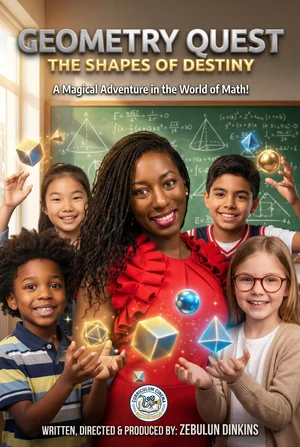
Denise Jonell
Educator
Denise Clark is an educator with over 20 years of experience with youths. For thirteen of those years, she has had the pleasure of being a Certified Elementary Teacher. The journey that led to this accomplishment, started with her first experience in school. Since she was in Kindergarten, Denise has had a unique enthusiasm for learning. Though some have found school to be intimidating, Denise always found it to be more sacred than anything. School for her was a place of safety, where she was allowed to use her imagination to bring excitement to what she was learning. Like most children, Denise did face disruptions in her education. These disruptions came from peer pressure, unprepared teachers, and also her socioeconomic background and low self esteem. To stay focused, she used Art and Writing to express herself and work on changing the things that were under her control. She is also the founder of Out of Psyght. Out of Mind. LESSON CONNECTIONS 4.G.1 ✔ Points, lines, line segments, rays, angles, parallel and perpendicular lines 4.G.2 ✔ Classifying quadrilaterals by parallel and perpendicular lines 4.G.3 ✔ Identifying and recognizing right triangles 4.G.4 ✔ Lines of symmetry and identifying line-symmetric figures Big Idea: Geometry helps us understand and describe the shapes, patterns, and structures that exist all around us.
Denise Clark is an educator with over 20 years of experience with youths. For thirteen of those years, she has had the pleasure of being a Certified Elementary Teacher. The journey that led to this accomplishment, started with her first experience in school. Since she was in Kindergarten, Denise has had a unique enthusiasm for learning. Though some have found school to be intimidating, Denise always found it to be more sacred than anything. School for her was a place of safety, where she was allowed to use her imagination to bring excitement to what she was learning. Like most children, Denise did face disruptions in her education. These disruptions came from peer pressure, unprepared teachers, and also her socioeconomic background and low self esteem. To stay focused, she used Art and Writing to express herself and work on changing the things that were under her control. She is also the founder of Out of Psyght. Out of Mind. LESSON CONNECTIONS 4.G.1 ✔ Points, lines, line segments, rays, angles, parallel and perpendicular lines 4.G.2 ✔ Classifying quadrilaterals by parallel and perpendicular lines 4.G.3 ✔ Identifying and recognizing right triangles 4.G.4 ✔ Lines of symmetry and identifying line-symmetric figures Big Idea: Geometry helps us understand and describe the shapes, patterns, and structures that exist all around us.
Play the Lesson. Earn the XP.
Interactive games built to reinforce our cinematic lessons and their standards. Sign in with a free account to play — every game feeds your XP, level, and leaderboard story.
FORCE OF DESTINY
A High-Speed STEM Action Adventure Inspired by Formula 1 Racing Theme: Physics of Motion, Forces, Momentum, Engineering, Electricity, Magnetism, and Advanced Materials
WINGS OF TIME
Take to the skies in the Chrono Flyer, a state-of-the-art time-traveling aircraft, and embark on an unforgettable journey across thousands of years of world history! In Skies of Empires: Flight Through History, players become young pilot Ava Reynolds and her team as they race through time to protect history from the mysterious villain, The Divider, who is determined to erase the events and ideas that shaped our world.
MAGICAL WORD TRAIN
The Magical Word Train A 2D educational platformer for 1st grade readers · Ages 5–8 · Playable in any web browser Climb aboard the Magical Word Train — a candy-colored steam engine that rides rainbow rails through the clouds! Choose your hero: Benny Badger with his mid-air double jump, Sunny the Fairy Cat who flutters gently down on fairy wings, or speedy Conductor Leo with the highest jump on the rails. Then run, hop, and glide across six enchanted stages that change with the weather and time of day — from bright sunny mornings and golden sunsets to starlit nights full of fireflies and a rain-soaked river where the wet rails get slippery. But this is no ordinary train ride: the tracks are made of words! In every level, players catch the right word bubbles to solve phonics challenges — finding words that rhyme with CAT, hunting for words that start with the sss sound, swapping one sound to turn CAT into BAT, snapping small words together into compound words like RAINBOW, blending sound chunks into whole words (/fl/ + /ag/ = FLAG!), and proving they know a book's title, author, illustrator, contents, and glossary. Wrong guesses never punish — they teach, with friendly hints that turn every mistake into a mini-lesson. At the end of each stage, a mischievous word-boss blocks the station: out-rhyme Rex the Rhyme Rat, out-smart Mumbles the Parrot, and dodge ink splats from Inky the Bookworm in quiz battles that review each skill. Win, and your hero hops into the glowing train car and chugs away — choo-CHOO! — to the next stop. Survive all six stages and face Grumble the Word-Mixer, a giant grumpy storm cloud whose lightning-filled final battle mixes every skill in the game. Calm his storm, and earn your Reading Star Certificate! With cheerful original music for every stage, hand-drawn characters, three hearts and checkpoints to keep things fair, and controls simple enough for small hands on keyboard or tablet, The Magical Word Train turns foundational reading practice into a joyride. Built to reinforce South Carolina 1st Grade ELA standards (ELA.1.F.1.2–1.7 and ELA.1.F.2.1): rhyming, alliteration, phoneme substitution, syllables and compound words, onset-rime blending, and print concepts. A companion to the film "The Magical Word Train" by Zebulun Dinkins.
THE NUMBER QUEST GAME
When a mysterious villain named Dr. Chaos steals the magical Number Crystal from Math Kingdom, numbers across the land become scrambled. Three young heroes—Maya, Jordan, and Leo—must travel through Place Value Mountain, Estimate Valley, and Addition Fortress to restore order. Along the way, they solve real-world math challenges involving ordering numbers, comparing values, rounding, estimating sums and differences, and solving addition/subtraction problems up to 100,000. If they fail, all math in the kingdom will disappear forever.
TBA
TBA
Classroom Technology, Cinema Style
Every Curriculum Cinema account ships with a full instructional toolkit — real-time standards intelligence, live in-video questioning, and a gamified student workspace.
Actionable standards mastery, charted from real evidence.
Empower every educator to track readiness all year long. The Mastery Lab correlates South Carolina and Common Core standards against your lesson library, then charts each student's mastery from watch-time and checkpoint evidence — with AI coaching reports and one-click intervention assignments.
- Toggle between SC, Common Core, and your own library's standards framework
- Per-standard mastery bars: Beginning, Developing, and Mastered at a glance
- Lumen AI writes targeted coaching reports and weekly intervention plans
Focus on ratio reasoning this week: re-watch "The Geometry of Infinity" checkpoints 2–3, then assign the intervention plan below…
A gamified workspace every student actually wants to open.
Every student gets a personal Learning Desk: XP levels and study streaks, daily quests, a course-progress gradebook, the teacher's live instructions, class stream discussions, and an AI-powered study notebook — all in one cinematic dashboard.
- XP, levels, academic titles, unlockable badges, and daily study streaks
- Daily quests for watching films, passing checkpoints, and logging notes
- Study notebook with AI summarizer, flashcard studio, and printable journals
Built to support teachers and captivate students
Every lesson is a cinematic experience wired with the assessment, AI tutoring, and mastery analytics a real classroom needs.
Cinematic Lesson Films
Story-driven video modules that make standards feel like a night at the movies — students press play because they want to.
Interactive Checkpoints
Mid-video questions and live pop-ups pause the film to check understanding in the moment, with XP and speed ranks on the line.
AI Voice Tutor
Students ask questions out loud and Lumen answers in text and speech — a patient one-on-one tutor inside every lesson, mutable anytime.
Standards Mastery Lab
Chart each student's mastery against South Carolina, Common Core, NGSS, and C3 standards — correlated automatically to your lessons.
One-Click Interventions
Spot a struggling standard and assign a targeted re-teach plan in one click. Students see it on their banner; the chart shows the growth.
XP, Levels & Streaks
A gamified progress engine keeps students coming back — every checkpoint, pop-up, and assignment feeds their level and leaderboard story.
One platform, three experiences
Everything connects — what students watch becomes what teachers measure.
For Students
A streaming-style catalog, checkpoints that feel like a game, a voice tutor that never runs out of patience, and XP that makes progress visible.
For Teachers
Rosters, a live completion matrix, homework grading, AI lesson plans and worksheets, standards mastery charts, and interventions — one dashboard.
For Home & Anywhere
Works in any browser, installs as a desktop app, and shines on the living-room screen with TV Mode — learning follows the student home.
Simple, Transparent Pricing
Cancel anytime from your profile — you keep access until your billing period ends.
Free Explorer
Perfect for trying the cinematic catalog
Premium Pass
The full classroom cinema, billed monthly
Premium Yearly Save 17%
Best for classrooms — one payment per school year
My Learning Desk
Track classroom progress, achievements, assignments, and study journals.
Student Name
Earn XP by playing films, interacting with checkpoints, and logging notes.
Teacher's Desk
Your teacher hasn't broadcasted instructions today.
Submit Assignment Work
Class Stream Discussion
Unlockable Badges
Daily Quests & Achievements
Refreshes per session completionMy Course Progress Gradebook
Study Notebook Explorer
Teacher Control Panel
0
0
0
0
AI Lesson Plan Creator
Generate customized syllabi, objectives, worksheets, and timing agendas matching any visual curriculum asset instantly using advanced AI tools.
Engagement Heatmap & Coach
Visual distribution of student activity levels across your active class roster:
Blackboard & Homework
No lessons match this filter.
My Classes
Create a class for each group you teach. Share its unique join code with students — they sign in with their username and that code, just like Google Classroom.
Student Registration
RosterInstantly generate accounts for students, invite them to register themselves using Class Code: CLASS-CODE, or import a bulk roster.
Format: columns "Full Name", "Username". Students are added to the class selected below and sign in with their username + class join code.
Students sign in with just their Username and the Class Join Code — no email or password needed.
Active Student Roster & Diagnostics
Your roster is stored in Firebase and loads on any device you sign in from. Click a student for full quiz & notes diagnostics.
No students match your search.
| Student Name | Username ID | Class | XP Level | Watched Videos | Quizzes Solved | Actions |
|---|
My Custom Classroom Lessons
Custom video resources loaded from external sources for your classroom.
| Poster | Title & Source URL | Category | Interactivity | Actions |
|---|
Live Gradebook & Pop-ups
Track student performance on all checkpoints and assign real-time pop-up questions.
Active Pop-Up Questions
Student Completion Matrix
| Student Name | Video Title | Question Type | Submitted Answer | Verdict | Speed Rank | Awarded XP | Manage |
|---|
Student Homework Submissions
| Student | Lesson | Submission Text | Grade | Actions |
|---|